EN — English
 TR — Türkçe
 DE — Deutsch
 RU — Русский
 FR — Français
 ES — Español
 AR — العربية
 SR — Српски

Eritrea Mine & Port Mobile Stone Crushing Plant 120-180 TPH
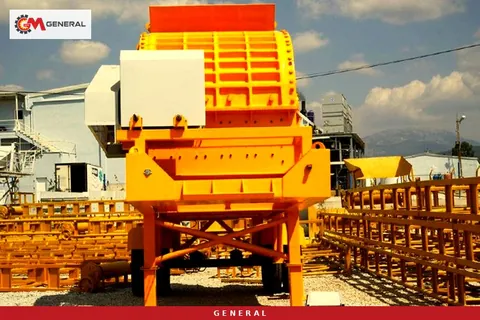
A contractor planning a crushing plant in Eritrea is often asked to solve two different jobs with one budget: reducing run-of-mine ore or waste rock at an inland mine site, and feeding material to a port, quay or reclamation job on the Red Sea coast. This article looks at a 120-180 TPH mobile stone crushing plant investment through that dual role. Every capacity, feed opening, generator and weight figure below comes from the technical data on our product pages. For the volume, schedule and material specification of any particular mining licence or port tender, the authoritative source is always the technical documentation of the relevant authority or employer; read the comparison here alongside that document.
What do a mine pit and a port site each demand from the same plant?
On paper the two jobs look alike: rock is crushed and screened in both. On site the expectations split. At the mine, the priority is to accept large, irregular run-of-mine feed safely, keep metal consumption under control in abrasive ore, and be able to reposition the plant as the pit face advances. At the port, the priority is to deliver a defined grading to stockpile continuously and in line with the specification.
Mine side: oversized ROM feed and hard ore
The block size coming from blasting directly dictates the primary crusher's feed opening. Our portable primary jaw units accept 0-1100 mm feed and deliver a 0-250 mm product; on the wheeled single-chassis lines this value is 700-800 mm depending on the model. The difference looks small, but at a mine it decides how many blocks the excavator has to break separately, and therefore how much of the daily output actually reaches the crusher. In quartz-rich or siliceous ore, a jaw primary wears metal more slowly than an impact primary because it works by compression.
Port side: fill, filter layers and quay concrete
Not everything a crushing plant produces on a port job goes to the same place. The outer armour stone of breakwaters and moles is usually large rock selected straight from the quarry and never passes through a crusher. The crusher's job is fill and core material, the filter layers beneath the armour, base material for the yard platform, and chippings for the concrete of the quay superstructure. That is why, on the port side, the number of screen decks and the particle shape can matter more than the crusher brand or model. The grading required for filter layers varies from project to project; take the values from the design documents.
Rock variety from the Red Sea coast to the highlands
Eritrea is geologically a mixed country. Granite, gneiss and metamorphic rocks are common in the highlands and interior; basalt dominates in the volcanic areas; and the coastal strip has coral-derived limestone and loose coastal deposits. This variety means no single assumption can drive the choice of crushing line: the quarry serving the port may be a limestone deposit close to the shore, while the mine site may hold hard, abrasive granite or quartz-veined ore.
Before the final choice, samples should be taken from both sources and tested for compressive strength, abrasion and clay content. The results settle two things: whether the second stage should be cone or impact, and how much pre-screening ahead of the primary matters. Anyone who wants to see how work on a similar rock was set up in the region can review our 150 TPH basalt crushing and screening project in Jijiga, Ethiopia; that project is in neighbouring Ethiopia, not in Eritrea, and is useful only as a guide to comparable rock.
Two routes to 120-180 TPH: a single-chassis line or separate portable units
Splitting the models that meet the target range into two groups makes the decision easier. The first group is the wheeled mobile crushing and screening plants that carry crusher and screen on one chassis. The second group is the portable rock crushers where each stage arrives on its own chassis. Every figure in the table below is taken from the respective model's product page; unknown cells are left as “—”.
| Configuration | Capacity | Max. feed | Crushers | Screen | Power | Weight |
|---|---|---|---|---|---|---|
| General 944 (single chassis) | 120-180 t/h | 800 mm | GPJ 90 jaw + GM430 cone | 1600×5000 mm, 3-deck | 550 kVA generator | 70,000 kg |
| General 950 (single chassis) | 120-180 t/h | 800 mm | GPJ 90 jaw + DMK01 impact | 1600×5000 mm, 3-deck | 600 kVA generator | 70,000 kg |
| General 01 (single chassis) | 120-180 t/h | 700 mm | GPS 1210 impact (primary + secondary) | 1600×5000 mm, 4-deck | 550 kVA generator | 55,000 kg |
| GNR 90 portable primary | 70-180 t/h | 0-1100 mm (series) | GNRK 90 jaw | — | — | 25,000 kg |
| M-DMK 01 portable secondary | 120-180 t/h | 0-350 mm | Impact (HSI), feeder with by-pass screen | — | 160 kW motor | 32,000 kg |
Why separate units suit the mine
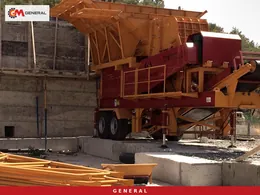
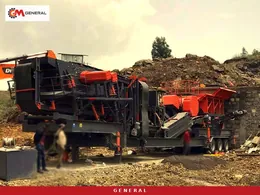
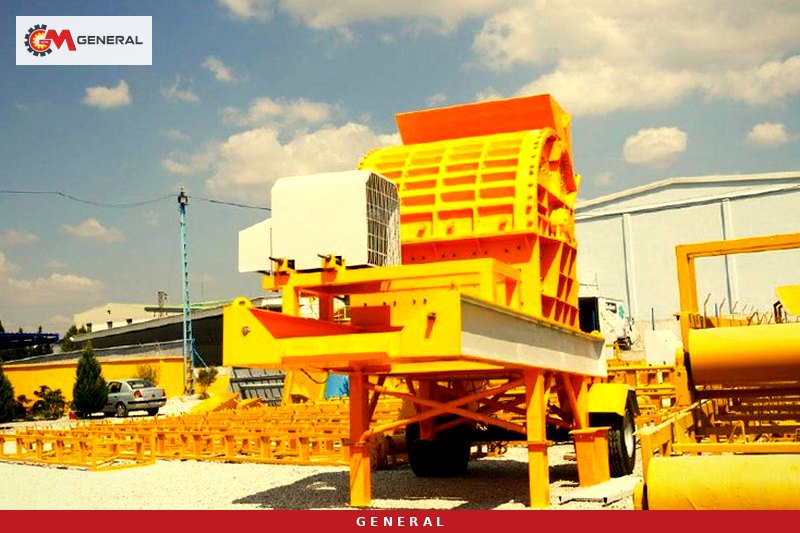
The portable primary jaw crusher with feeder hopper can operate on its own. That gives real flexibility for Eritrea's dual role: the first phase of a port job mostly needs coarse fill and core material, and the 0-250 mm product from the primary may come close to that requirement. When chippings and filter material are needed, the M-DMK 01 portable secondary impact crusher and a separate screen are added. One point to watch: at its lower end the GNR 90's 70-180 t/h range can drop below the M-DMK 01's 120 t/h minimum, so the primary has to be held at the target tonnage for the two units to work efficiently together. Also, an impact secondary wears blow bars quickly in highly abrasive basalt or granite; if the mine rock falls in that class, consider a cone solution for the secondary stage.
When does the single-chassis line pull ahead?
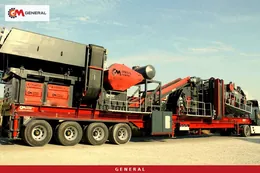
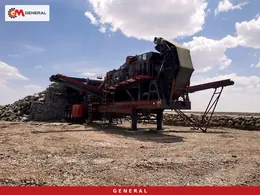
If the plant will stay on one site for a long time and the product list is fixed from the start, a single-chassis line simplifies set-up and cabling. In hard, abrasive rock, the cone second stage of the General 944 gives an advantage in wear-part life; where cubical shape and a high reduction ratio matter more, the General 950, with the same dimensions and weight, comes forward. In low-abrasion material such as coastal limestone, the General 01, which combines primary and secondary crushing in a single impact body, can send separate fractions for quay concrete to stockpile in one pass thanks to its 4-deck screen.
Salt air, humidity and dust: operating precautions on the coast
A crushing line on a port site faces a different wear pattern from an inland quarry. Salt in sea air speeds up corrosion on exposed steel surfaces and electrical connections, while hot, dusty spells on the coast put strain on generator cooling and air filters. Precautions that can be selected per project for these conditions include:
- Keeping the electrical panel and motor connections in closed, sealed enclosures and checking the inside of the panel regularly.
- Touching up paint damage periodically and washing salt deposits off the chassis with fresh water.
- Cleaning generator and engine air filters more often in dusty periods and keeping spare filters on site.
- Water-spray dust suppression at the crusher discharge and conveyor transfer points; laying out stockpiles near the shore according to wind direction.
- Reviewing greasing intervals for bearings and housings to suit humid air.
Which of these items enter the scope of the quotation is decided together once the site's distance from the shore and the plant's operating period are clear.
If the valley floor yields clayey material
On coastal plains and in dry riverbeds, material with a high share of clay and fine soil is common. A grizzly feeder can blind in such sticky material and carry clay into the jaw, increasing wear. In that case the mobile jaw crushing unit with a wobbler feeder is an option: stones travelling over the rotating shafts tumble and shed surface clay and fines, so cleaner material enters the jaw. However, that unit's 250-450 t/h capacity is above the 120-180 TPH range this article targets. It therefore belongs on the table only for projects where clay content has been confirmed by testing and production volume is expected to grow.
Shipping via Massawa or Assab and getting to site
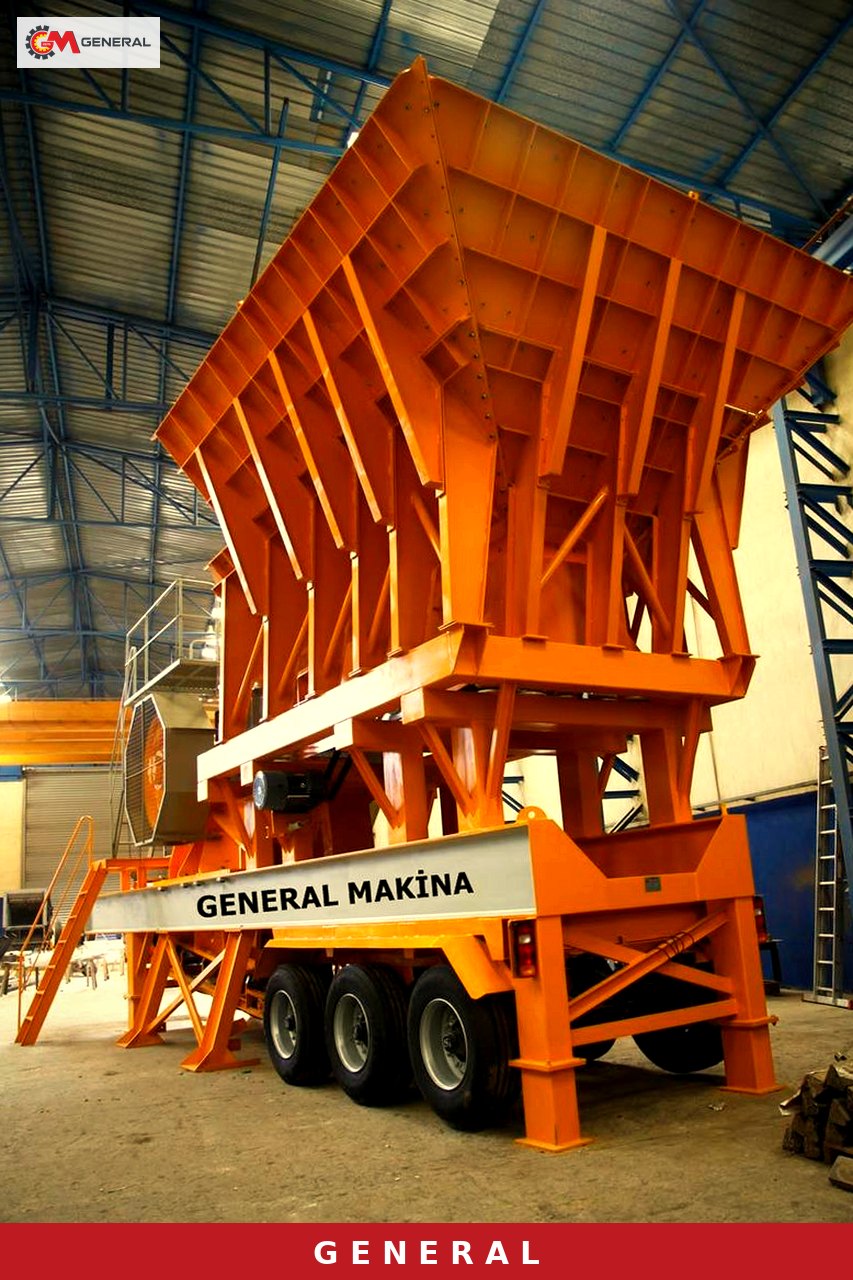
The two main sea gateways for a plant bound for Eritrea are the ports of Massawa and Assab. Roads climbing from the coast to the highlands can include steep, winding sections, so the transport dimensions and weight of the units matter as much as capacity. Portable primary units are a single chassis and are towed by one truck. The General 944 and 950 have a transport size of 4130×20350×4500 mm and weigh 70,000 kg; the General 01 measures 4300×18500×4500 mm and weighs 55,000 kg. Checking bridge and bend restrictions along the route with a local haulier in advance can also influence the choice of unit type. For more on stage arrangement, see our article on primary, secondary and tertiary crusher layout on a mobile plant chassis.
If you send the following information together with your enquiry, the configuration can be settled in the first conversation:
- Rock type on the mine and port sides, any test reports and the estimated clay content.
- Largest block size after blasting.
- Products required for the port job: fill, filter material, base material, concrete chippings, and the grading of each.
- Daily operating hours and target hourly tonnage.
- Power source: generator or grid connection?
- How many times the plant will move between the two sites, and route information.
Frequently asked questions
Can the same plant work at both the mine and the port?
Yes, being mobile makes that possible. But if the rock at the two sites differs, the wear behaviour of the second stage changes too. In that case a set of separate units is usually more flexible, because it lets you keep the primary at the mine and take the secondary to whichever site needs it.
Can coral limestone be crushed into aggregate for quay concrete?
That depends entirely on the material's test results. Coral-derived limestone can be porous and variable in strength; its suitability as concrete aggregate is determined by laboratory tests and the project specification. The crushing line should be chosen after those results are in.
What about warranty and certification?
Our machines carry a 1-year warranty; wear parts are excluded. Production holds ISO 9001 and CE certification. We have been manufacturing in Izmir since 1976 and export mainly to North Africa and the Middle East, among other regions.
What determines the price and delivery terms in a quotation?
The chosen configuration, whether a generator is included, the number of screen decks, any extra measures requested for coastal conditions and the shipping scope are the main items that set price and delivery terms. Once these are clear, a quotation is prepared specifically for you.
Conclusion: first the product list for both sites, then the model
When choosing a 120-180 TPH mobile crushing and screening plant to handle mine and port work together in Eritrea, the first step is to write down the rock and the required products for each site separately. For hard, abrasive ore and a long stay on one site, the General 944 is a strong candidate; where cubical shape comes first, the General 950; and for low-abrasion coastal material, the General 01. For a job that will move often between sites and grow in phases, a split set made up of a GNR 90 primary and an M-DMK 01 secondary is more flexible. Send your rock data and product list through our contact page and we will prepare the right configuration and quotation for your project together.
Definitions of technical terms: Glossary