EN — English
 TR — Türkçe
 DE — Deutsch
 RU — Русский
 FR — Français
 ES — Español
 AR — العربية
 SR — Српски

Eritrea Copper-Gold Jaw Aggregate Crusher Plant 200-300 TPH
A team opening a copper-gold deposit in Eritrea puts two different jobs on its primary crusher: in the first months, aggregate for haul roads, pads and concrete; once the plant is running, ore for the concentrator circuit. This article builds a 200-300 TPH jaw crushing line around those two phases. It puts the GNRK 110 jaw crusher at the centre and compares two layouts that pair it with a GNR vibrating feeder and a G-type grizzly screen. Every model value in the tables comes from our product catalogue.
We give no information on the licence, reserves, operator or expansion schedule of any particular mine. For product size, environmental conditions and installation permits, work from the mining company's technical specification and the requirements of the relevant Eritrean authority.
Gossan, oxide and sulphide zones in Arabian-Nubian Shield ore
Eritrea's mineral potential sits in the Precambrian basement rocks known to geologists as the Arabian-Nubian Shield. Volcanogenic massive sulphide (VMS) deposits in this belt carry copper, zinc and gold in the same body. Near the surface there is a loose, iron-oxide-rich gossan cap, and gold often becomes economic in this oxide zone. Deeper down the ore passes into an enriched copper zone and then into massive sulphide.
For the crusher these three zones are three different materials. Gossan and oxide ore are soft, dusty and locally clayey, so they can blind the grizzly and pack the crusher mouth. Massive sulphide is heavy and dense; it carries more tonnes per cubic metre and loads belts and hoppers harder. The host rock is mostly silicified volcanic rock, and that is what actually wears the jaw plates. Selecting the line for the hardest zone and then adjusting feed and pre-screening in the soft zone produces fewer surprises than the reverse.
Learn the rock make-up of your own deposit from samples, not from this general picture. Silica content and Bond abrasion index (Ai) tests tell you directly which alloy and which crusher type fit. Our catalogue threshold: when silica exceeds 10% or Ai exceeds 0.15, a jaw crusher working by compression is the safe choice at the primary stage.
Aggregate first, ore later, through the same crusher
On a remote copper-gold site the first tonnes go to construction, not to the concentrator. Mine roads, truck ramps, tailings embankments, mill foundations and camp buildings all need crushed stone and concrete aggregate. Crushing waste rock on site usually makes more sense than hauling aggregate in from far away, and that is why the title stresses aggregate.
Construction phase: road base and concrete aggregate
At this stage the jaw output alone is not enough. The catalogue discharge range of the GNRK 110 is 150-225 mm; for road base and concrete this material has to pass through a secondary crusher and screens. A cone crusher accepts 50-250 mm feed at the secondary stage (300 mm on some settings), so the GNRK 110 product can go straight to it. In silicified volcanic rock a cone crusher consumes less metal than an impact crusher. Secondary options are in our crushers category.
Operating phase: ore ahead of processing
Once the plant is commissioned, the jaw crusher is tied into the ore line. Product size is then set by the feed limit of the next crushing or grinding circuit rather than by an aggregate specification. Planning this switch from day one avoids moving the crusher, the stockpile area and the conveyor directions twice. When the aggregate stage is removed or relocated, the primary station can stay where it is.
Two GNRK 110 layouts for 200-300 TPH
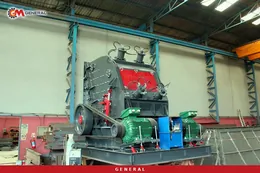
Among the catalogue jaw crushers, the model that covers 200-300 TPH on its own is the GNRK 110 jaw crusher: 1100×850 mm opening, 110/132 kW motor, 33,000 kg and 200-350 t/h. The GNRK 90 tops out at 225 t/h, so it cannot reach 300 t/h alone. The GNRK 130, at 400-500 t/h, is oversized for this duty, although it is worth discussing if tonnage is expected to grow.
| Unit | Opening / pan (mm) | Discharge (mm) | Motor (kW) | Weight (kg) | Capacity (t/h) |
|---|---|---|---|---|---|
| GNRK 90 jaw | 900×650 | 70-180 | 75/90 | 11,400 | 60-225 |
| GNRK 110 jaw | 1100×850 | 150-225 | 110/132 | 33,000 | 200-350 |
| GNRK 130 jaw | 1300×1000 | 125-250 | 160 | 42,500 | 400-500 |
| Portable GNR 110 (feeder + GNRK 110) | 1100×4750 (feeder) | 0-250 | — | 55,000 | 180-300 |
| GNR 110 vibrating feeder | 1100×4750 | — | 2×7.5 | — | 200-300 |
| GNR 140 vibrating feeder | 1400×5000 | — | 2×9.2 | — | 350-600 |
Stationary station on concrete foundations
The GNRK 110, the GNR 110 feeder and a G-type grizzly screen are mounted on a concrete structure. Trucks tip straight into the hopper and the belt under the crusher takes material to the stockpile or the secondary stage. This layout suits an ore station that will stay in one place for the life of the mine. Hopper volume on the feeder models is chosen per project within 15-100 m³; truck size and tipping frequency drive that choice.
Portable primary jaw unit
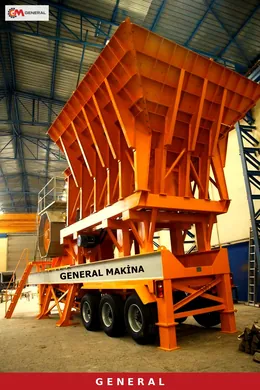
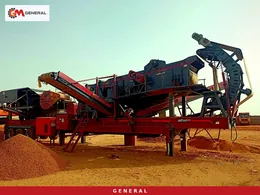
The portable GNR 110 unit combines a 1100×4750 mm armoured feeder and the GNRK 110 jaw crusher on one chassis. It accepts 0-1100 mm feed, delivers 0-250 mm product, runs at 180-300 t/h and weighs 55,000 kg. Hydraulic legs let it stand without foundations. During construction it works beside the waste dump making aggregate, then moves once the ore line is ready. When planning, keep in mind that its lower limit is 180 t/h, while the crusher in the stationary layout runs at 200-350 t/h.
Feeder and grizzly: removing oxide-zone fines
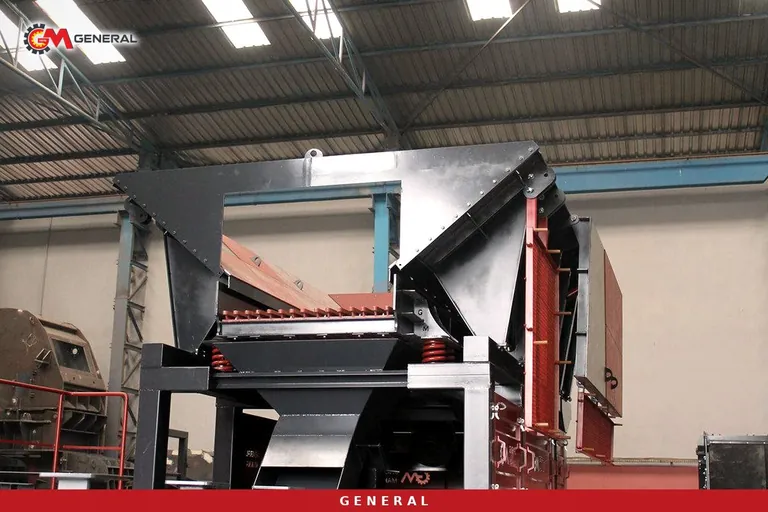
In gossan and oxide ore a large share of the run-of-mine already arrives fine. Passing it through the jaw wastes capacity and wears the plates. The grizzly section at the end of the GNR vibrating rock feeder drops fines and soil onto the by-pass belt without sending them through the crusher. Large rock travels over the bars into the crusher mouth at a steady rate and keeps the chamber choke-fed.
For a 300 t/h target, the GNR 110 feeder (1100×4750 mm, 2×7.5 kW, 200-300 t/h) works in the same band as the crusher. An operator wanting headroom at peak tonnage can look at the GNR 140 (1400×5000 mm, 2×9.2 kW, 350-600 t/h); its pan is wider than the crusher opening, so the transfer chute must be designed with it. The feeder takes material up to 1500 mm, while the crusher accepts lumps of only about 0.8-0.9 times its opening width. Close that gap with the blast pattern and by breaking oversize in the pit with a hydraulic breaker.
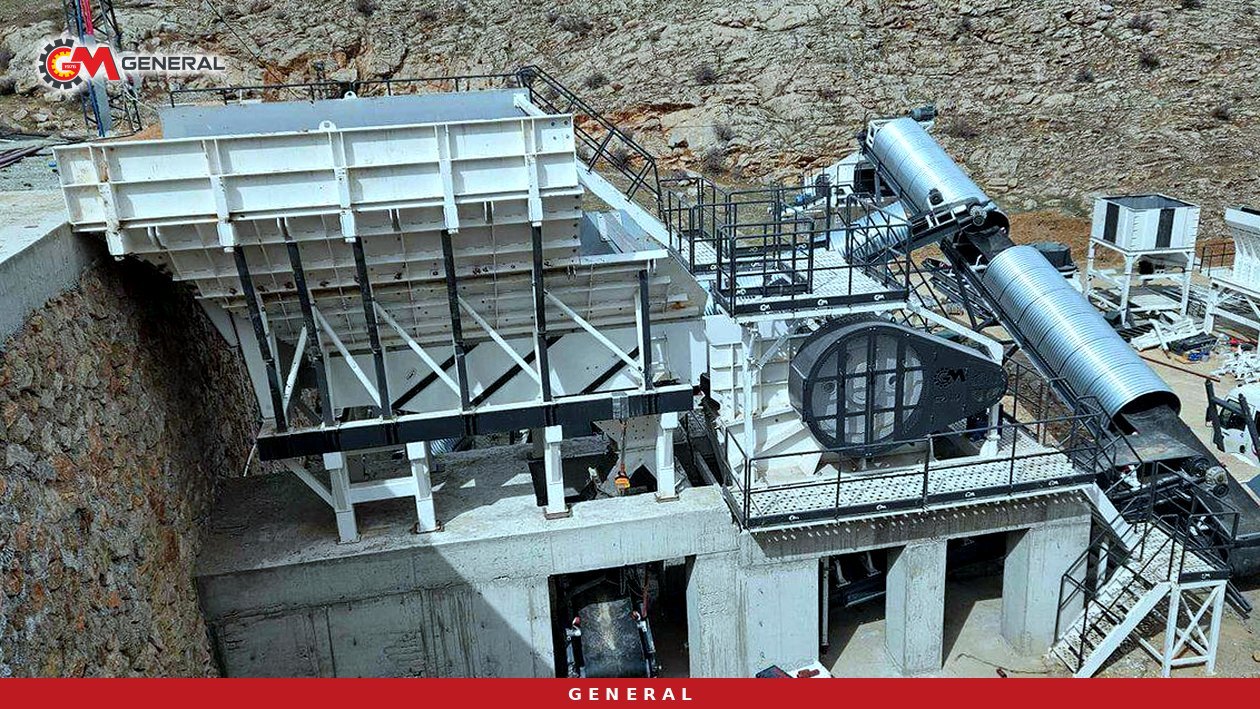
If a sharper split is wanted on the by-pass line, a G-type grizzly screen is added. The ELKG-1930 is listed with a 1200×3000 mm deck, 11.5 kW motor and 6,500 kg weight. Its bars are Mn13-type austenitic manganese castings whose surface work-hardens under impact from about 200 HB to 450-550 HB. Bar spacing is adjustable, so it can be set wide in oxide ore and narrow in sulphide. If clayey oxide material blinds the grizzly in the wet season, a wobbler feeder should be put on the table as an alternative.
Jaw plate selection in silicified host rock
Jaw plates are standard austenitic manganese steel (Mn13/Mn18); Mn18 or Mn22 is recommended for high-silica material. On VMS sites the plates are worn less by the ore than by the silicified volcanic rock around it. Wear can therefore be faster during construction, when aggregate is made from waste rock, than during ore crushing. Choose the alloy for the rock that will enter the crusher most often, not for the ore sample.
Reduction is typically 4:1 to 9:1 and reaches about 8:1 at the primary stage. Adjust the CSS as wear progresses and measure the product size once per shift; when the lower part of the plate wears, the product coarsens and the secondary crusher works harder. Symmetrical plates can be turned to gain a second life. Plan spare plates and grizzly bars against the distance of the site, because the waiting time for a part coming from the port is downtime for the crusher. Jaw, grizzly and liner options are listed on our spare and wear parts page.
Installation from the Red Sea ports to the highlands and western lowlands
Shipments to Eritrea usually go through Massawa or Assab, with road transport to site. Altitude and climate change markedly between the highland plateau around Asmara and the Gash-Barka lowlands in the west. That brings two decision points. At high altitude diesel generator and electric motor output drops, so generator selection should use the manufacturer's altitude derating table. In the hot, dusty lowlands, engine cooling, panel ventilation and air filters move to the front.
A stationary station means concrete foundations plus water and cement logistics, which can stretch the schedule on a remote site. The portable unit sits on one chassis and needs no foundation. Where water is scarce, covered belts, curtains at transfer points and low-flow spraying at the crusher discharge are measures that can be selected per project instead of high-volume wetting. The site's environmental specification decides which of them are needed.
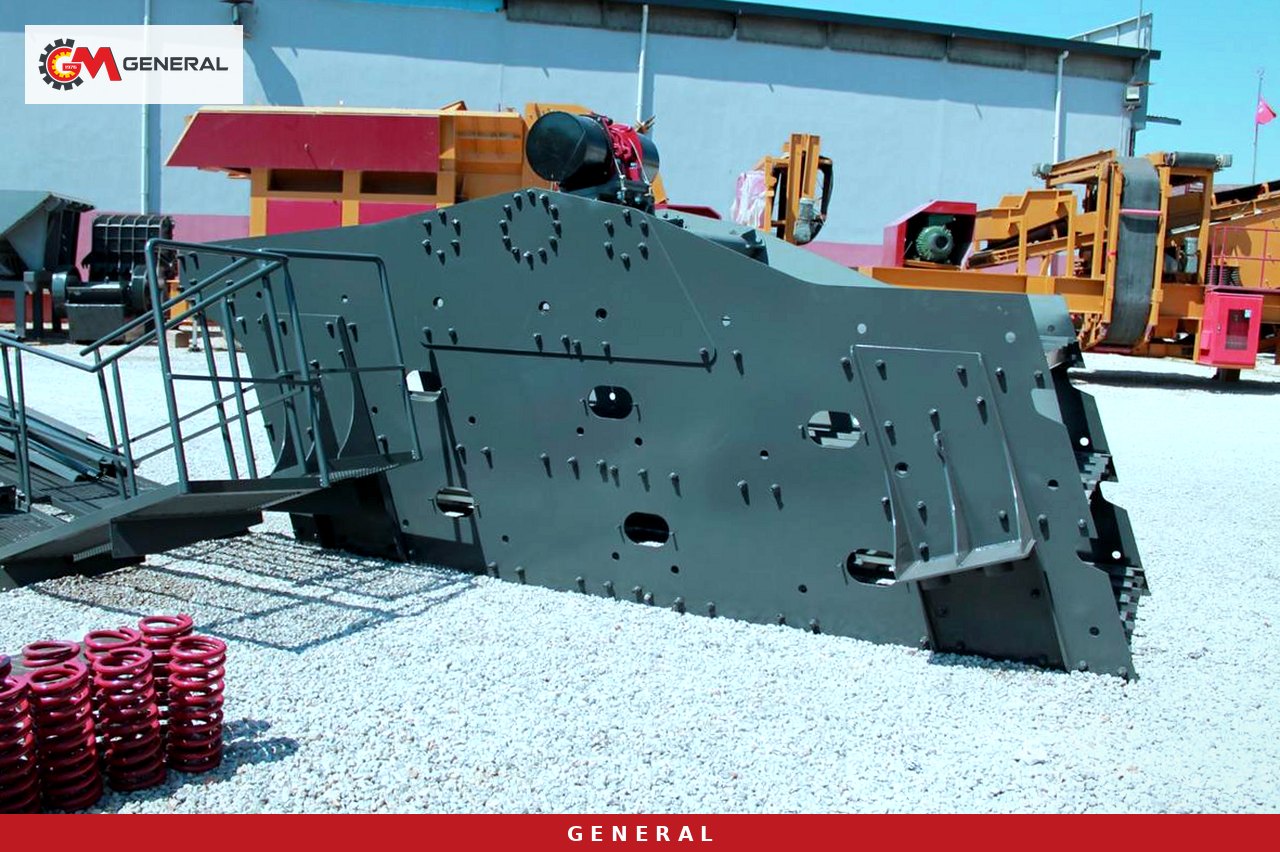
Weights go straight into the transport plan: the GNRK 110 alone is 33,000 kg and the portable GNR 110 unit 55,000 kg. Check bridge and bend limits on the route from port to site with the haulier in advance.
What the enquiry file should contain
- Samples from each zone (gossan, oxide, sulphide and host rock) with silica content and Ai value.
- Expected largest lump after blasting and truck or loader capacity.
- Aggregate fractions required during construction and their estimated tonnages.
- Top feed size required by the next circuit during operation.
- Site altitude, power source (grid or generator) and available water.
- Stationary or portable preference, station location and a stockpile sketch.
With this data the line goes beyond a single crusher choice: feeder, grizzly, belts and secondary stage are sized together. Complementary machines are in our stationary crushing plants and vibrating feeders categories.
Frequently asked questions
Why a jaw rather than an impact crusher as primary for copper-gold ore?
Silicified host rock and sulphide ore are abrasive. A jaw crusher working by compression uses metal far more slowly in this material than an impact primary.
Can a single GNRK 110 handle 300 t/h?
Yes, its catalogue range is 200-350 t/h. Actual tonnage depends on feed size, moisture, the share of fines removed at the grizzly and the CSS, and should be confirmed with samples and site data.
What happens to the secondary stage after the aggregate phase?
The primary station is connected to the ore line. The secondary crusher and screens can stay on site or be separated, depending on aggregate demand; show this transition in the layout plan from the start.
What determines warranty cover and the quoted price?
Our machines carry a 1-year warranty excluding wear parts, and we hold ISO 9001 and CE certification. The price depends on the model, stationary or portable layout, whether a grizzly screen and secondary stage are included, electrical equipment and shipping method.
A short route to the decision
For a 200-300 TPH jaw crusher on an Eritrean copper-gold site, the GNRK 110 is the centre of the line. If the station will work at one point for the life of the mine, the stationary layout fits; if it must move between construction aggregate and production ore, the portable GNR 110 unit is the better match. Send us your sample results and site data and we will work out the configuration together: write to us through our contact page for a quotation.
Definitions of technical terms: Glossary