EN — English
 TR — Türkçe
 DE — Deutsch
 RU — Русский
 FR — Français
 ES — Español
 AR — العربية
 SR — Српски

Erbil & Sulaymaniyah Mobile Crushing & Screening Plant 120-180 TPH
A contractor working between Erbil and Sulaymaniyah rarely solves the aggregate question with a single quarry. On one side are the housing blocks, commercial buildings and ring-road links going up on the Erbil plain; on the other, the hillside housing estates, retaining walls and fresh road cuts around mountainous Sulaymaniyah. The route between the two cities runs over mountain passes and winding roads, so the machine that finishes one job is often towed a few months later to another site near the other city. This article explains how to choose a mobile crushing and screening plant rated at 120-180 TPH for the way construction actually runs in these two cities: which crusher chain suits which rock, when an extra unit is needed for concrete sand, how to match the crushing line to a batching plant, and what operators should watch on a site that behaves differently in every season. All figures come from the technical tables on our product pages; confirm tender or specification values with the relevant authority.
Two cities, one fleet: what aggregate demand looks like on Northern Iraq sites
Building work in the region does not call for a single product. Reinforced-concrete buildings need washed or low-dust fine aggregate plus 5-12 and 12-19 mm chippings; road jobs need base and sub-base material; fill and drainage take coarser sizes. A plant is expected to turn out two or three of these products in the same week, so deck count and product flexibility matter more than headline capacity.
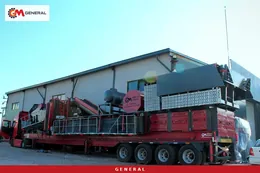
The second deciding factor is how often the plant will move during the year. On the flat sites around Erbil a line can stay put for months. On the Sulaymaniyah side, crushing rock from hillside excavation on the spot often makes more sense than trucking it away, which means frequent tear-down and set-up. A single-chassis wheeled plant saves time in that scenario; a multi-section stationary line means cranes, foundations and cabling at every move. The full wheeled range is on our mobile crushing and screening plants page.
Rock in the Zagros foothills: from limestone to hard bands
Quarries around Erbil and Sulaymaniyah are generally dominated by limestone and dolomite; in the mountainous parts you meet harder siliceous layers here and there, and rounded gravel in the river beds. That broad picture is not enough to decide for a particular quarry. Within the same licence area a chert or quartz-rich band can appear beneath soft limestone, and that band will eat the blow bars of an impact crusher faster than expected.
Tests to commission before ordering: Los Angeles abrasion, compressive strength, silica (quartz) content, and moisture and clay content. Samples should come from different benches of the quarry face, not from one spot. The results decide the crusher type directly: low-abrasion limestone suits a primary impactor, while high-silica hard rock calls for jaw pre-crushing followed by a cone or impact second stage.
Three wheeled candidates in the 120-180 TPH band
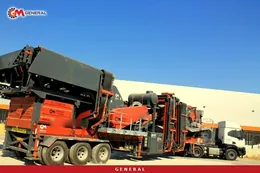
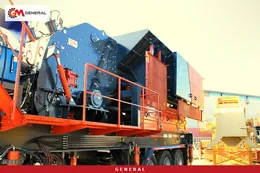
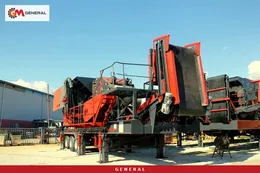
Our range has three models that cover this capacity on a single chassis. All three run in the same tonnage band; they differ in crushing principle, feed opening and screen layout.
| Model | Crusher layout | Max. feed | Screen | Generator | Weight |
|---|---|---|---|---|---|
| General 944 | GPJ 90 jaw + GM430 cone | 800 mm | 1600×5000 mm, three-deck | 550 kVA | 70,000 kg |
| General 950 | GPJ 90 jaw + DMK01 impact | 800 mm | 1600×5000 mm, three-deck | 600 kVA | 70,000 kg |
| General 01 | GPS 1210 impact (primary+secondary) | 700 mm | 1600×5000 mm, four-deck | 550 kVA | 55,000 kg |
General 01: limestone-dominated quarry with a four-product list
The General 01 performs primary and secondary crushing in one GPS 1210 impactor. Because its four-deck screen can deliver 19-40 mm as a separate product, it suits an Erbil site that needs both building-concrete aggregate and road-base material. Being the lightest of the three with the shortest transport length also makes it easier to manoeuvre on the mountain road towards Sulaymaniyah. Its limit is abrasiveness: on a hard, siliceous band the wear-part consumption of an impactor climbs quickly.
General 944 and 950: jaw pre-crushing for stone from hard bands
When hard, abrasive rock dominates the quarry, the jaw-primary models move ahead. The General 944 puts a GM430 cone behind its GPJ 90 jaw; because it crushes by compression, metal life is long in abrasive stone. The General 950 pairs the same jaw with a DMK01 impactor, giving a higher reduction ratio and more cubical grains, at the cost of more frequent wear-part changes in siliceous rock. If tests show high silica, the 944 is the sensible starting point; if cubical shape is the priority and the rock is of medium hardness, start with the 950.
The concrete sand bottleneck: when to add a VSI tertiary unit
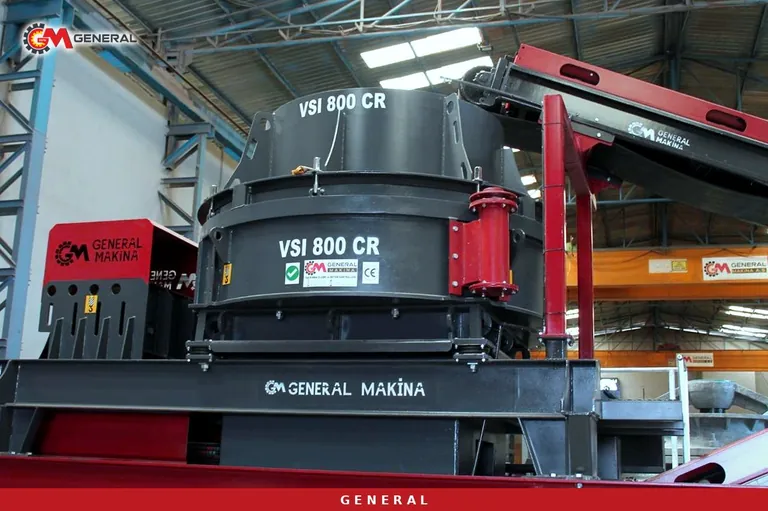
The 0-5 mm fraction from a crushing and screening line does not always meet a concrete sand specification. Flaky particles and grading in the fines coming off an impactor or cone can drift from what a ready-mix producer wants. This is where the mobile tertiary crusher (sand making machine) comes in. It works on the vertical-shaft impact (VSI) principle, rock-on-rock; it accepts 0-200 mm feed, produces 0-10 mm crushed sand and runs at 60-250 t/h.
The unit turns hard-to-sell oversize from the main plant into concrete sand. In periods of heavy housing construction in Erbil and Sulaymaniyah, demand for fine aggregate can overtake demand for chippings; a VSI unit then converts the coarse stockpile into a revenue line. It is not mandatory in the first investment, but the main plant's feed conveyor and stockyard should be laid out so that such a unit can be added later.
Aggregate flow from the crushing line to the batching plant
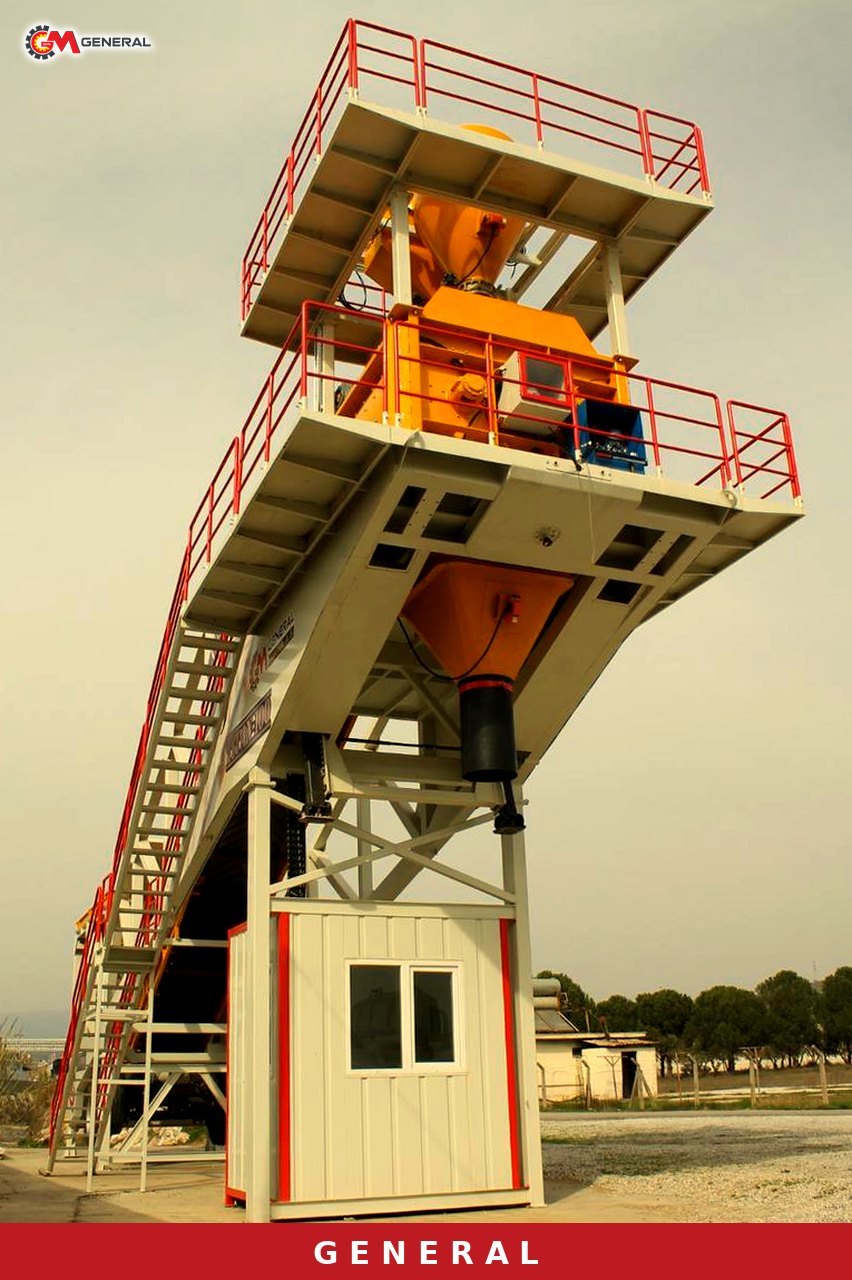
Many contractors in the region consider setting up a batching plant next to the crusher and producing their own ready-mix. The two plants then have to be sized against each other. The M-Titan 100 in our mobile concrete batching plant series produces 100 m³ of concrete per hour; its twin-shaft mixer runs on 2×45 kW motors and its aggregate bin holds 4×15 m³.
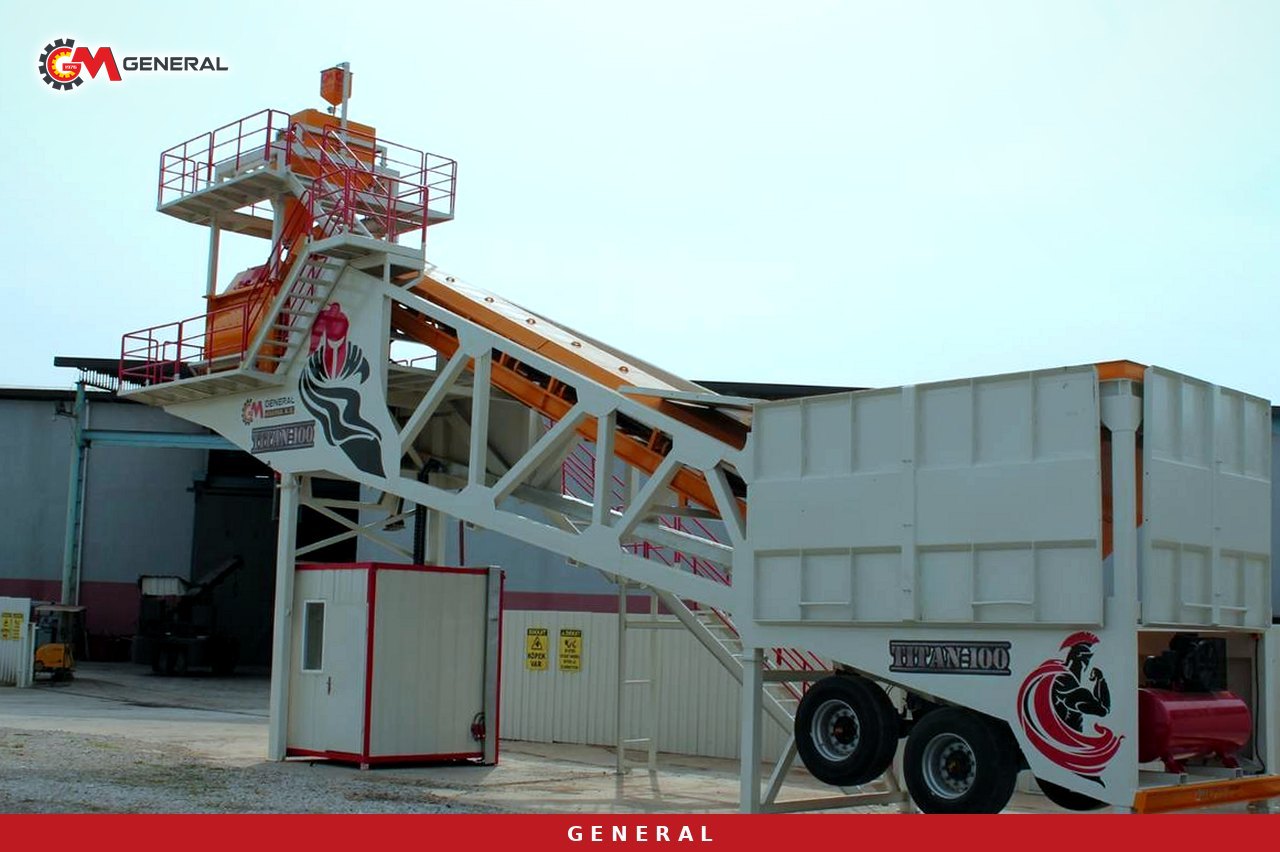
A rough check tells you whether the crushing line can feed the batching plant: hourly aggregate demand = target plant output (m³/h) × total aggregate in the concrete mix design (t/m³). Compare that figure with the crusher's output in each relevant fraction; check every fraction in the mix separately rather than total tonnage. If the crusher runs one shift and the batching plant two, the stockyard bridges the gap. All batching plant models are in the concrete batching plants category.
A four-season site: heat, dust, rain and power
Summers in Northern Iraq are hot and dry; winters are cold and wet, especially in the mountains. The same plant fights dust in summer and muddy feed and frozen surfaces in winter. Fill in this checklist for your site before installation:
- Dust: water-spray dust suppression at the feed point, crusher discharge and conveyor transfers; covered conveyors as an option on sites near housing.
- Cooling and filters: shorter air-filter change intervals for the generator and hydraulic unit in the hot season, regular radiator cleaning.
- Wet feed: if clay and moisture rise in winter, review the grizzly pre-screen opening and watch for blinding on the screen mesh.
- Power: a grid connection is not ready on every site; the generator follows the data sheet: 600 kVA on the General 950, 550 kVA on the other two models.
- Ground: compact the platform the plant will stand on at hillside sites and place load-spreading plates under the hydraulic legs.
- Spare parts: keep wear parts such as jaw plates, blow bars and screen mesh on site for the first months.
On logistics, the plants can be dispatched by road from Izmir. The transport length of the 944 and 950, above 20 metres, calls for a route survey on the winding passes of the Erbil-Sulaymaniyah corridor; check bridge and tunnel limits with the haulage company in advance.
Frequently asked questions
I will crush limestone in Erbil; do I need a jaw-primary model?
If tests show low abrasiveness, usually not. The General 01, which does both stages in a single impactor, is lighter and delivers four product sizes. If a hard band turns up in the quarry, the decision should be reviewed.
Can I move the same plant to my next site near Sulaymaniyah?
Yes. All three models are single-chassis wheeled plants towed by one truck. Before moving, compare the transport dimensions with the route and prepare a level, compacted platform at the new site.
Do I need a separate washing plant for concrete sand?
If clay and dust in the rock are low, crushed sand from the VSI unit is often enough. Quarries with high clay content need sand washing added; the decision follows the sample results.
What determines price and delivery time?
The model, crusher layout, generator, dust suppression, any add-on units and the shipping method shape the quotation. Send us your quarry data and product list and we will prepare an offer for your project.
Conclusion
When choosing a 120-180 TPH mobile crushing and screening plant for construction in Erbil and Sulaymaniyah, have the rock tested first, then fix the product list and how often the plant will move. The General 01 is a strong candidate for limestone sites needing four products, the General 944 for hard siliceous rock and the General 950 where cubical shape comes first; a VSI tertiary unit can be planned in for a concrete sand shortfall and a mobile batching plant for ready-mix. General Makina has been manufacturing in Izmir since 1976; our plants are ISO 9001 and CE certified and carry a 1-year warranty excluding wear parts. Request a quotation with your quarry data through our contact page.
Definitions of technical terms: Glossary