EN — English
 TR — Türkçe
 DE — Deutsch
 RU — Русский
 FR — Français
 ES — Español
 AR — العربية
 SR — Српски
How to plan crushing plant lead time and shipment realistically
Why lead time is never a single number
Procurement almost always opens with "how many weeks to delivery". In practice, crushing plant lead time is not a manufacturing calendar on its own. It is the sum of four blocks that queue behind each other: freezing the configuration, building and assembling, preparing the site on the buyer's end, and transport with customs clearance. The more of these run in parallel, the shorter the total; run in series, even excellent factory performance will not save the date.
The goal of planning is not a shorter date but a predictable one. A plant arriving two weeks late is usually manageable. Not knowing which week it arrives leaves every dependent item suspended, from the crusher foundation and the transformer connection to the crane hire.
The four blocks and what drives each
| Block | Content | What drives the duration | Buyer's responsibility |
|---|---|---|---|
| Configuration | Capacity, number of stages, screen media, options | How many rounds technical approval takes | Settle material analysis and product range |
| Manufacturing | Chassis, crusher, screen, conveyors, control panel | Stock position and special requests | Return approved drawings without delay |
| Site preparation | Foundations, power, access road, drainage | Concrete curing and grid connection permits | Finish before the plant ships |
| Transport and customs | Loading, routing, documentation | Oversize permits and border congestion | Collect paperwork early |
The third row is the one that decides most schedules. Site preparation sits entirely with the buyer, and when it slips the plant waits at the works instead of on site, which turns into storage and reloading cost.
Road gauge, the most underestimated constraint
Standard maximum road dimensions are largely harmonised across Turkey and the European Union. Once a load exceeds them, the movement becomes an abnormal transport with its own permit, routing, timing and escort conditions.
| Dimension | Standard limit | Note |
|---|---|---|
| Width | 2.55 m | 2.60 m for refrigerated and insulated vehicles |
| Height | 4.00 m | Measured from the ground, load included |
| Articulated vehicle length | 16.50 m | Tractor and semi-trailer together |
| Road train length | 18.75 m | Truck and drawbar trailer together |
In Turkey, permits for loads beyond these limits are issued by the General Directorate of Highways; inside the European Union a separate permit is required from the road authority of every country on the route. Permits are written for a specific vehicle configuration, axle load diagram and approved itinerary. Bridge capacity, turning radii and overhead clearances are checked one by one during the route survey, and pilot vehicles or a police escort may be imposed depending on how far the load exceeds the limits.
Where a mobile plant has the advantage
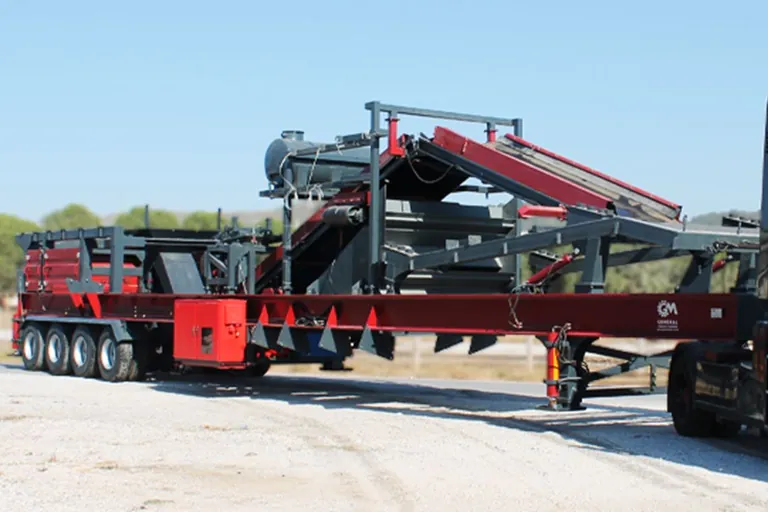
A mobile crushing plant is designed with folding conveyors and a trailer-mounted chassis so that it can be brought close to standard dimensions on most routes. A stationary plant, by contrast, travels in pieces and is assembled on site, which is a deliberate trade between transport simplicity and erection time. The decision rests on the number of pieces, the mass of the heaviest single item and crane access at the destination.
Sea freight: choosing the loading method
For overseas shipment, cargo dimensions and mobility decide the loading method.
| Method | Suits | Governing constraint |
|---|---|---|
| Open top container | Cargo too tall for the doors, crane loaded | Internal length about 12.03 m, internal width about 2.35 m |
| Flat rack | Wide or heavy loads that may overhang | No side walls, overhang beyond the base is possible |
| RoRo | Wheeled or towable machinery | Ramp gradient and clear height |
| Breakbulk | Oversized items that cannot be containerised | Crane capacity and stowage plan |
Container dimensions vary slightly by carrier and container age, so exact internal figures are confirmed with the line before booking. High cube open top variants offer more internal height than the standard type, and that difference occasionally decides whether a component has to be dismantled at all.
Documents, the item that quietly extends the calendar
Even a finished transport plan stalls at the port or the border when paperwork is incomplete. The headings to gather early are the commercial invoice and packing list, the certificate of origin, the declaration of conformity with the technical file, the insurance policy, the packaging declaration and, where required, an inspection report. Some import regimes ask for prior approval on specific items, and if those approvals do not run alongside manufacturing, the total calendar stretches. Comparable discipline on the spare parts side is collected under procurement and supply.
A buyer's checklist
Putting six facts in writing before contract removes most later disputes: delivery term and named place, mass and dimensions of the heaviest single piece, total number of pieces to be moved, width and gradient of the site access road, crane capacity needed for offloading, and how long the commissioning team stays on site. Once those six are settled, the delivery date stops being an estimate and becomes a planning input.
Common questions
What stretches lead time most?
Late technical approval and unfinished site preparation lead the list. Both can be closed before manufacturing even starts.
How long does an oversize permit take?
It depends on the country, the route and how far the load exceeds the limits, which is why the application should be tied to the day the route is fixed rather than to the loading date.
Should the plant ship whole or in pieces?
That follows from the heaviest piece, bridge limits along the route and crane access on site. Shipping whole shortens erection and increases the permit burden.
When must site preparation be finished?
Before the plant leaves the works, allowing for concrete curing. A load arriving at an unprepared foundation generates both storage and reloading cost.
Definitions of technical terms: Glossary