EN — English
 TR — Türkçe
 DE — Deutsch
 RU — Русский
 FR — Français
 ES — Español
 AR — العربية
 SR — Српски
Crushing Circuit Bottleneck Identification
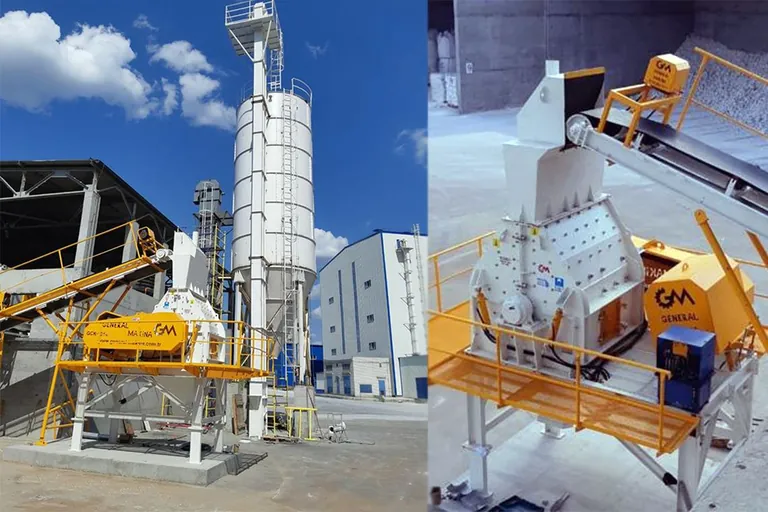
When a circuit rated at 100 t/h finishes the shift at 62 t/h, the loss is rarely spread evenly across the machines; it usually sits in one station. Crushing circuit bottleneck identification is the work of finding that single station with measurable evidence. Any improvement made before the constraint is known simply adds capacity where there was already surplus.
Why the slowest station sets the number
In a series circuit the nominal ratings of the machines are not additive. Material passes from the feeder to the primary crusher, then to the secondary stage and the screens, in that order. The slowest station in the chain dictates the pace of everything upstream and downstream of it. Speeding up a non-constraint machine therefore does not raise output; it only grows the pile in front of the constraint.
The cheapest way to find the constraint is not new equipment but disciplined observation. Walking the circuit for one full shift and watching how material behaves at every transfer point answers the question in most plants.
Step one in crushing circuit bottleneck identification: build-up and starvation
The station immediately after a pile-up is a candidate; the station immediately before a gap in the flow is a candidate. Two signs are worth writing down:
- Build-up: the bin stays full, the belt runs heaped, material packs in the chute mouth, the feeder is throttled or stopped repeatedly.
- Starvation: the crushing chamber runs half full, the belt shows gaps, no bed forms on the screen deck.
The table below links the symptom recorded on the shift sheet to the likely constraint. Treat it as a triage list; the verdict still comes from measurement.
| Observed symptom | Likely constraint | Verification step |
|---|---|---|
| Primary bin always full, feeder throttled | Primary crusher or its discharge belt | Watch the belt loaded and empty; check chamber fill level |
| Secondary chamber only half full | Starvation upstream or surge stock handling | Log surge bin level every thirty minutes |
| Thick bed on the deck, oversize carrying over | Screening area or screen loading | Weigh oversize and undersize flows separately |
| Recirculating belt carrying more than expected | Poor screening efficiency, grown circulating load | Compare recirculation flow with fresh feed |
| Belts stopping and starting frequently | A station further downstream | Trace which relay issues the stop signal |
Step two: actual-to-nominal ratio by stage
Observation nominates; the ratio convicts. For every stage the tonnage actually passing through is compared with the capacity range published for that machine. If a mobile jaw-and-impact set is rated 40-70 t/h and the lower bound of 40 t/h is taken as the working reference, a measured 38 t/h means that stage is straining, while 22 t/h means the constraint lies elsewhere.
Weighbridge tickets, truck counts or a belt scale all serve as the measurement source. Where none exists, stockpile volume and loose bulk density give an approximate tonnage, and an approximation still beats no measurement at all. The table below shows how a shift record is laid out; the figures are worked assumptions and must be replaced with data from your own circuit.
| Stage | Nominal lower bound (t/h) | Measured flow (t/h) | Ratio | Reading |
|---|---|---|---|---|
| Feeder | 80 | 64 | 0.80 | Spare capacity |
| Primary crusher | 70 | 64 | 0.91 | Close to the limit |
| Secondary crusher | 60 | 58 | 0.97 | Candidate |
| Screening | 60 | 59 | 0.98 | Candidate |
| Product belt | 90 | 59 | 0.66 | Comfortable |
Two stages share the highest loading here. To separate them, measure the oversize stream and the recirculating stream apart from each other: if the circulating load exceeds expectation, screening is the constraint.
Step three: reading motor current
Current is the most direct statement of how much work a crusher is doing. A trace that sits close to rated full-load current with little scatter says the chamber is full and evenly fed. Persistently low and ragged current means the feed is starving. Repeated peaks with the overload relay tripping point to overfeeding, harder rock or fines packing in the chamber.
The panel ammeter or the drive display is enough for this; no extra instrumentation is required. Read the current together with the build-up notes: if current is low while material piles up in front of the machine, the fault sits in the transfer or the chute geometry rather than in the crusher.
Step four: screening capacity, the constraint most often missed
When screening area falls short, correctly sized material stays on the deck and travels back to the crusher on the recirculating belt. That returning load spends crusher power and wear parts on rock that has already reached product size. Output drops while the crusher looks busy, and the real constraint is the screen.
The checklist is short: does a bed form on the deck, are the apertures blinded by sticky fines, does the aperture match the product specification, are slope and speed correct, is the surface area adequate for the flow. When a vibrating screen is selected, the area required for the flow matters as much as the aperture size.
The order in which a constraint is relieved
Once the constraint is known, work through it in this order: first what an adjustment fixes (feed balance, aperture, closed side setting, deck slope), then what a part change fixes (media type, worn liners), and only last what an investment fixes (added screening area, an extra stage). Solving an adjustment problem with capital means buying the same constraint again together with new equipment.
When one constraint is relieved the circuit tightens somewhere else. That is the expected outcome, not a failure, and the measurement loop simply starts again. Making that loop part of the shift routine is what turns plant efficiency work into a durable gain.
Frequently asked questions
Is a belt scale mandatory for this?
No. Truck counts, weighbridge tickets and volume-based estimates are accurate enough to expose the ratio between stages. A belt scale makes the job easier; it is not a precondition for the decision.
Is one shift of observation enough?
One shift nominates a candidate. Because moisture, face conditions and operator habit move the result, the measurement should be repeated over several shifts and under different material conditions.
What if two stages show the same ratio?
The recirculating stream decides. A large returning load points to screening; a crusher current that keeps peaking points to the crushing stage.
Definitions of technical terms: Glossary