EN — English
 TR — Türkçe
 DE — Deutsch
 RU — Русский
 FR — Français
 ES — Español
 AR — العربية
 SR — Српски

Chippings Price vs Profit: Aggregate Crushing Plant 150-250 TPH
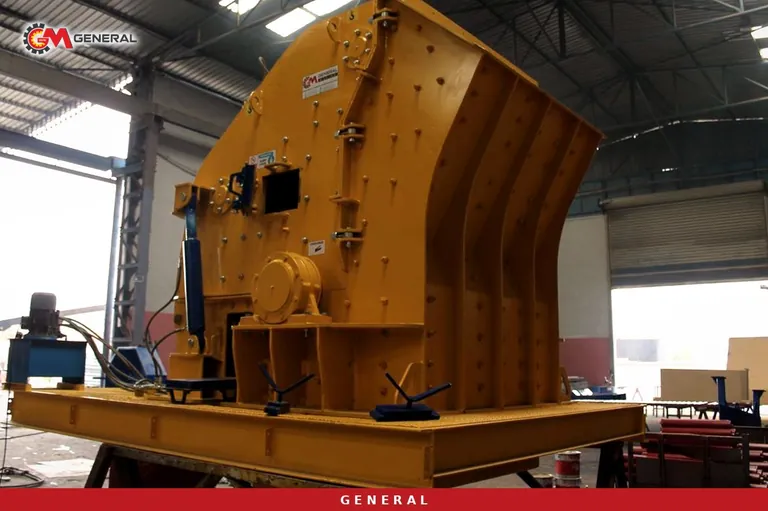
An investor usually opens a crusher feasibility study with one number: the local price of chippings per tonne. That number is multiplied by hourly capacity, the result looks encouraging and the calculation stops there. Real quarries do not work that way. A line running at 150-250 TPH cannot sell all of its feed as chippings; part of the output is sand and dust, part is coarse material, and each has its own buyer and its own price. In this article we build, line by line, the table that turns the chippings price into real profitability: fraction shares, cost per tonne, model selection and the effect of grain shape on price. We use "units" instead of a currency. Sales figures in the examples are assumptions; machine data come from our product pages.
Market chippings price versus the plant's real revenue
The price quoted at the quarry normally refers to the 5-12 and 12-19 mm fractions that concrete and asphalt producers want most. The plant's revenue is the sum of each fraction's tonnage multiplied by that fraction's own price. Written as a formula: hourly gross revenue = Σ (fraction tonnes × fraction price). Hourly operating cost is subtracted from this, and the remainder multiplied by annual operating hours gives the yearly gross contribution. Depreciation and financing are paid out of that contribution.
The formula hides two traps. First, the capacity figure refers to feed; the tonnage leaving the screen as saleable product can be lower because of the recirculation loop and fines that cannot be stockpiled for sale. Second, the chippings price applies only to product that meets the specification. A 12-19 mm with a high flaky grain share or too much dust is either sold at a discount or sits on site. If the profitability table ignores both cases, the investment stays on paper.
The fraction split decides which way profit goes
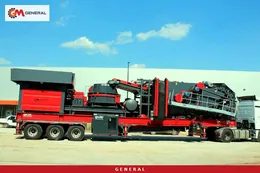
The same 200 TPH of feed produces very different revenue in two quarries with different rock and settings. Crusher discharge setting, number of stages and screen meshes decide which stockpile each tonne lands on. Plants with four-deck screens, such as General 02 and GNR-MC110, separate four products: 0-5, 5-12, 12-19 and 19-40 mm. The three-deck screen of General 944 gives 0-5, 5-12 and 12-19 mm. Do not choose the screen layout before finding out which fraction actually sells in the region.
Tonnes crushed and tonnes sold are not the same
A plant rated at 250 tonnes tells you the crusher and screen can handle that tonnage. On the sales side, the number to watch is what is loaded onto trucks at the end of the day. The gap is made up of soil-laden material removed at pre-screening, oversize returning to the circuit and fractions waiting for a buyer in the stockyard. Showing that gap as a separate line in the feasibility study makes the table presented to a bank or partner realistic.
The stockpile risk of 0-5 mm dust
Impact crushers give cubical product but also generate fines. If there are manufactured sand buyers in the region, this fraction adds to revenue. If not, the pile grows, the yard shrinks and loader time is wasted. Some operations wash the fines and sell them as concrete sand, turning 0-5 mm into income. That decision depends on demand from local batching plants and on water availability.
A hypothetical hourly revenue example
The table below only illustrates the method. Fraction shares and prices are assumptions; real values come from the test results on your quarry sample, the screen openings and local buyer prices.
| Fraction | Assumed share | Tonnes per hour | Assumed price (units/t) | Hourly revenue (units) |
|---|---|---|---|---|
| 0-5 mm | 30% | 60 | 6 | 360 |
| 5-12 mm | 25% | 50 | 10 | 500 |
| 12-19 mm | 25% | 50 | 10 | 500 |
| 19-40 mm | 20% | 40 | 7 | 280 |
| Total | 100% | 200 | — | 1640 |
In this example more than half of revenue comes from the two chippings fractions. If the chippings price falls by one unit, hourly revenue drops by 100 units; if the 0-5 mm price falls by one unit, the loss is 60 units. A sensitivity analysis is done fraction by fraction like this, and it shows clearly which product's price the operation depends on most.
Items that make up cost per tonne
On the cost side, wear parts, energy, staff, loading equipment and downtime shape the table. Depreciation and financing are added on top. To talk about profit per tonne, each item is converted into an hourly amount and divided by saleable tonnes per hour: cost per tonne = total hourly cost / saleable tonnes per hour.
Wear parts and rock hardness
In limestone, the blow bars of an impact crusher are changed at reasonable intervals and the cubical product advantage stands out. In high-silica rock such as basalt and granite, the same impact crusher eats parts quickly; there, jaw and cone crushers working on compression bring the wear cost per tonne down. Jaw crusher plates are cast in manganese steel and work-harden on the surface under impact. Do not put a figure on wear until the quarry rock is known; have an abrasiveness test run on a sample and build the line item on that result. The energy and wear cost per tonne calculator on our site can be used for a first draft of this calculation.
Energy: generator or grid
Wheeled plants come with their own power unit: 660 kVA on General 02, 750 kVA on GNR-MC110 and 550 kVA on General 944. At a quarry close to the grid, the difference between a power connection and diesel becomes a visible line in cost per tonne. On a remote site the generator is the only option and fuel logistics join the calculation. Fuel or power consumption should be worked out at quotation stage for the chosen configuration and rock; a generic figure misleads the table.
Operating hours and downtime
The variable that moves yearly contribution most is often not the price but the hours the plant actually produces. Blockages, screen mesh changes, belt slip and waiting for parts come straight out of revenue. Write operating hours in the revenue formula after deducting the maintenance plan, not optimistically. Keeping spare wear parts on site is the most concrete measure for shortening downtime.
Real model options for the 150-250 TPH range
Configurations that meet the target range differ by rock type and by how long the plant stays on one site. All values in the table come from the relevant model's product page; cells without data are marked with a dash.
| Configuration | Capacity (t/h) | Feed / opening (mm) | Screen | Power | Suitable rock |
|---|---|---|---|---|---|
| General 944 (GPJ 90 jaw + GM430 cone) | 120-180 | 800 | 1600×5000 mm, 3 decks | 550 kVA | Basalt, granite, quartz |
| GNR-MC110 (GPJ 110 jaw + DMK03 impact) | 200-300 | 900 | 2000×6000 mm, 4 decks | 750 kVA | Hard rock incl. basalt and granite |
| General 02 (GPS 1413 primary impact) | 250-300 | 1000 | 2000×5000 mm, 4 decks | 660 kVA | Limestone and low-abrasive rock |
| Fixed line: GNRK 110 jaw + GNR DMK02 + GNR K110 cubicizer | 200-350 / 170-250 / 160-250 | 1100×850 opening | — | 110/132 + 200 + 160 kW | Limestone, medium-abrasive rock |
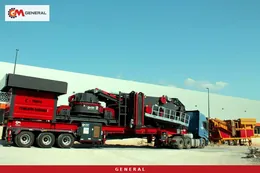
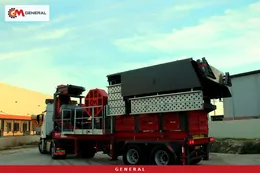
General 944 is the single-unit answer for a quarry that processes hard rock and sits in the lower half of the range. For a basalt quarry aiming above 180 TPH, the GNR-MC110 two-platform jaw line stands out; because its primary chassis can also run alone, the investment can be split into two steps. In limestone, General 02 delivers 250-300 TPH on one chassis and covers the top of the range comfortably. For an operation staying many years at the same quarry, fixed stone crushing and screening lines allow more screen decks and a larger feed opening. All wheeled options are listed on the wheeled mobile crushing and screening plants page.
How grain shape affects the chippings price
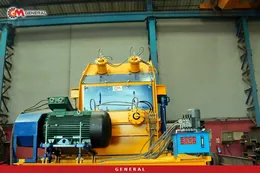
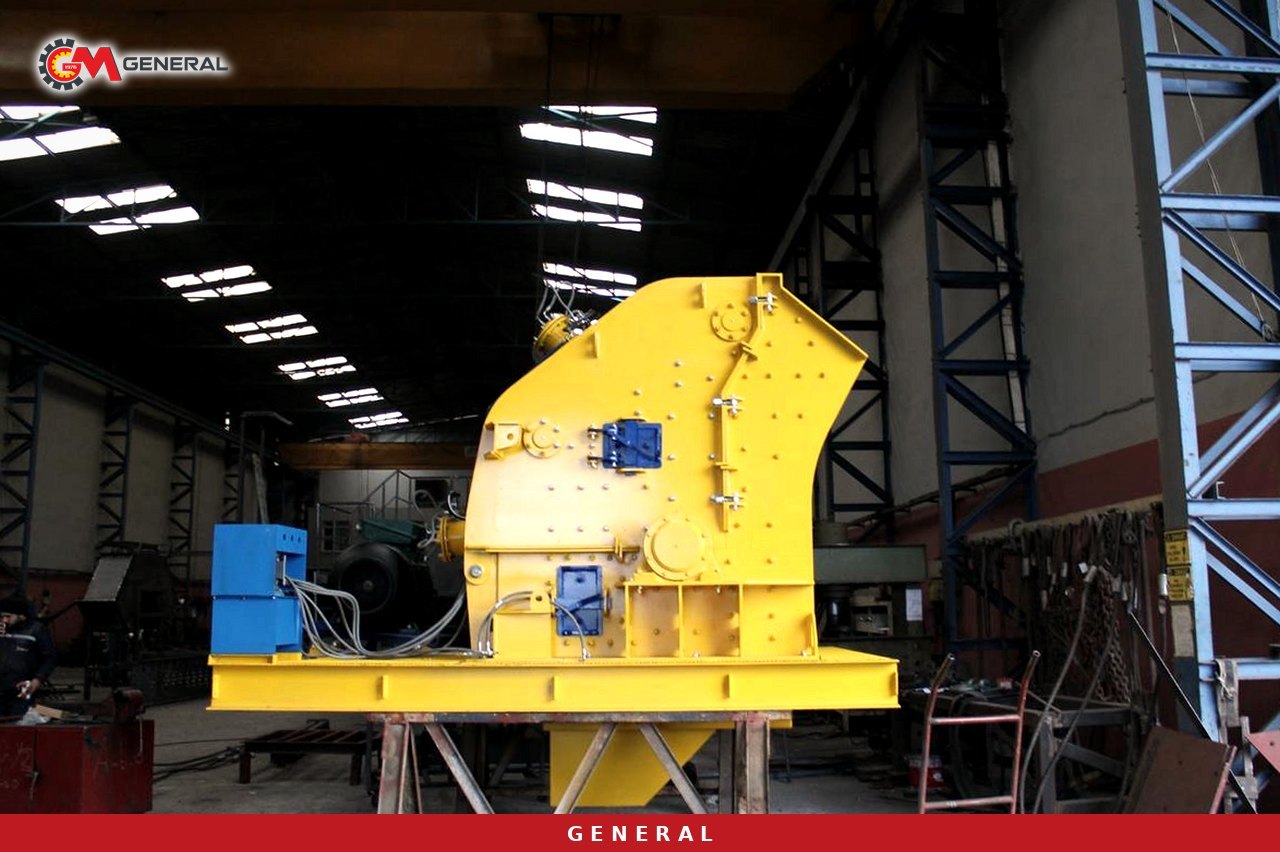
Asphalt and concrete producers filter chippings in the laboratory by flakiness index. Cubical product with few flaky and elongated grains passes the specification first time and avoids discounts and rejection. The GNR K series cubicizer crusher is added to the line for exactly this job: it does little reduction, it breaks flaky grains and reshapes them. On the GNR K110 the rotor is 1550×1800 mm, maximum feed 210 mm, capacity 160-250 t/h and motor power 160 kW. Those values fit straight into the last stage of a 150-250 TPH line. For a smaller second line there is the GNR K100 (90-130 t/h, 90 kW).
The cubicizer adds to profit in two ways. It reduces off-spec tonnage and so raises the saleable share. Some buyers also pay more for product that meets the shape requirement. The size of that premium varies by region; before the investment decision, obtain in writing the technical specification of your target buyers and the price they pay for cubical product. If grains larger than 210 mm are sent to the cubicizer, shaping improves less and wear rises, so the discharge setting of the stage before it is adjusted to suit the cubicizer.
Calculation checklist before the investment decision
Before asking for a quote and taking the profitability table to a bank, prepare a written answer to each of the items below:
- Abrasiveness and compressive strength test results on a representative quarry sample.
- The fractions local buyers want and a written price offer for each one.
- Flakiness and fines limits in the target specification.
- A buyer or a washing option for 0-5 mm, and a water source.
- Distance to grid power; without a connection, the fuel logistics of running on a generator.
- Realistic annual operating hours, number of shifts and planned maintenance days.
- Time on site: a single quarry, or moving between several sites.
- Spare wear part plan and its effect on downtime.
Frequently asked questions
Which configuration holds up better if the chippings price falls?
When prices fall, the line with the lowest cost per tonne and the highest saleable share survives. In hard rock that is usually the jaw and cone layout; in limestone, a primary impact line with a cubicizer. Product variety also protects you: a screen that separates four products reduces dependence on the price of any single one.
Is a cubicizer needed at every quarry?
No. If your buyers set no shape requirement, or the second stage already gives cubical product within specification, a cubicizer is an extra investment. If you will sell chippings for asphalt wearing courses and high-strength concrete, evaluate it together with the sample test.
Is a mobile plant or a fixed line more profitable?
For an operation working many years at one quarry, a fixed line with a larger opening and more screen decks lowers cost per tonne. For an investor serving several sites, or with a short quarry permit, a wheeled plant saves paying for foundations and erection again with every move. Make the comparison on the same rock and the same operating hours.
What information determines the quoted amount?
Model, number of stages, number of screen decks, added units such as a cubicizer or washing, generator or grid connection and shipping method make up the quote. The price is given per project once this information is clear.
A last note for the decision
The chippings price per tonne is only one cell in the profitability table. The real table is completed by fraction shares, wear and energy cost per tonne, actual operating hours and the effect of grain shape on saleability. General Makina has been building crushing and screening plants in Izmir since 1976; our machines carry ISO 9001 and CE certification and a 1-year warranty excluding wear parts. Send your sample results, target fractions and site details through our contact page, and we will prepare the configuration and quote for your 150-250 TPH target together.
Definitions of technical terms: Glossary