EN — English
 TR — Türkçe
 DE — Deutsch
 RU — Русский
 FR — Français
 ES — Español
 AR — العربية
 SR — Српски

Cameroon Hydropower Dam Aggregate Crushing Plant 250-375 TPH
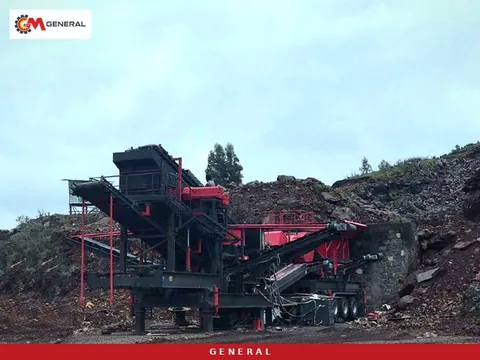
A contractor setting up an aggregate plant for a hydropower project in Cameroon usually starts by asking which crusher will deliver 300 tonnes an hour. On a dam site the deciding factor is something else: the dam type and the concrete specification. A roller-compacted concrete (RCC) body, mass concrete, the powerhouse, the spillway and the penstock concrete each call for different size fractions, different sand contents and different cleanliness limits. The Sanaga river and its tributaries form the basin most often mentioned in connection with the country's hydropower investments, and most of these sites sit on crystalline basement rock in a wet, densely vegetated region. This article shows how to reach the 250-375 TPH target with real catalogue machines, why sand becomes the bottleneck and how to keep producing through the rainy season. We do not give information on the volume, schedule or specification of any particular dam; confirm these with the employer and the project specification.
A dam site consumes aggregate in three waves
Aggregate demand on a hydropower job never follows a flat line. Both tonnage and product list shift with the construction phase. Sizing the plant for a single peak means idle capacity in the first year and a sand shortage during the dam body pour.
Diversion works, cofferdams and access roads
In the first months the work concentrates on the river diversion, temporary cofferdams, the camp and the roads into the valley. This phase needs sub-base, base course, rockfill and drainage filter material rather than concrete aggregate. Tolerances are wide, but the haul routes are long and scattered. A wheeled jaw primary plus one secondary unit covers this period, and the same machines later become part of the main line.
Dam body concrete
This is where the main consumption begins. RCC or conventional mass concrete draws several fractions in fixed proportions on the same day, and the batching plant cannot wait for aggregate. This is the phase in which the target climbs into the 250-375 TPH band. Because the sand content is high, fines production sets the real limit of the crushing line.
Powerhouse, spillway and penstock
In the final phase total volume drops and the specification tightens. Reinforced structural concrete needs a smaller maximum aggregate size, good particle shape and low fines. Part of the line can be shut down at this stage or moved to another job, which is the flexibility mobile units provide.
Cameroon's bedrock: gneiss, granite and basalt in the west
The centre and south of the country lie largely on Precambrian crystalline basement. Gneiss, granite and migmatite are the rocks most often met in quarries. Basalt is common along the volcanic belt that follows the western highlands. Limestone is more limited and tied to sedimentary basins; finding it right next to a dam site is the exception.
This geology drives crusher selection directly. Gneiss and granite are high-silica, abrasive rocks. A jaw crusher breaks by compression and keeps metal wear low on such stone. An impact crusher gives a more cubical product on the same rock, but blow bar and liner changes become more frequent. The foliated texture of gneiss can produce flaky particles; if the dam concrete has a flakiness limit, a shaping stage is needed at the end of the line.
Before deciding anything about the quarry rock, take samples and have a laboratory run Los Angeles abrasion, flakiness index and alkali-silica reactivity tests. Dam concrete stays in contact with water for decades, and reactive aggregate carries a long-term cracking risk in the structure. The crushing line is drawn from these results, not the other way round.
Configurations that cover the 250-375 TPH band
The figures in the table are catalogue values. A single wheeled chassis will struggle to cover this band from start to finish in hard rock, so we set out three routes. All wheeled options are listed on the mobile crushing plants page.
| Model / layout | Primary | Secondary / tertiary | Capacity | Feed | Screen | Power unit |
|---|---|---|---|---|---|---|
| General 03 | GPS 1415 impact | — | 250-375 t/h | 900 mm | 2400×5000 mm, 4-deck | 750 kVA |
| GNR-MC110 | GPJ 110 jaw | GS1215 / DMK03 impact | 200-300 t/h | 900 mm | 2000×6000 mm, 4-deck | 750 kVA |
| Mobile primary jaw GNR 110 | GNRK 110 jaw | — | 180-300 t/h | 0-1100 mm | — | — |
| Mobile pre-screening DMK | — | Two-chamber impact, integrated pre-screen | 40-300 t/h | 0-100 mm | Vibrating pre-screen | — |
| Mobile VSI tertiary unit | — | VSI, rock-on-rock | 60-250 t/h | 0-200 mm | — | — |
One chassis: the General 03 and its limits
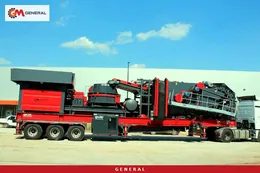
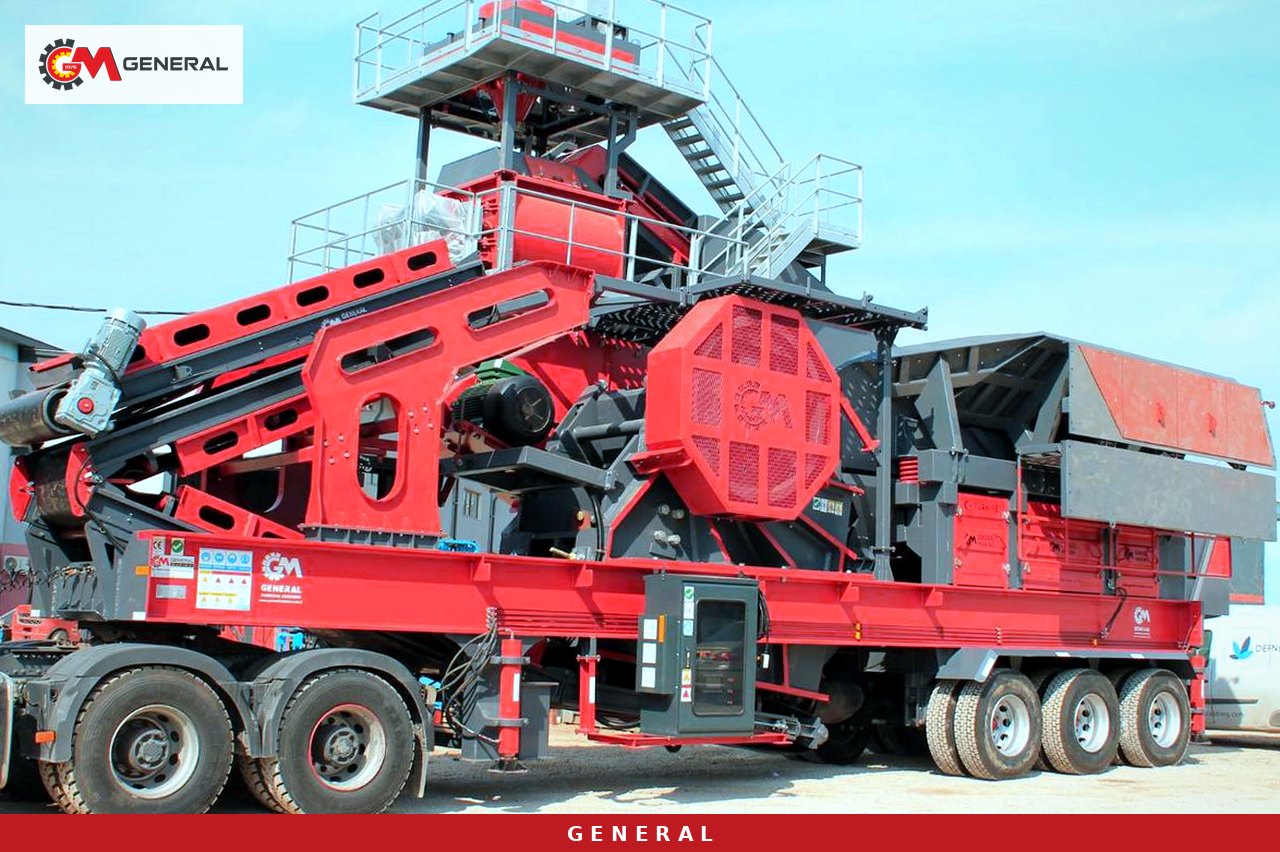
The General 03 is our only wheeled model that spans the whole band: a GPS 1415 primary impact crusher, 900 mm feed, a 2400×5000 mm four-deck screen and four products of 0-5 / 5-12 / 12-19 / 19-40 mm. It comes on a four-axle chassis with a 750 kVA power unit. With an impact primary it makes sense on limestone and medium-hard rock. In a gneiss or granite quarry it can hold this output, but wear parts turn into one of the largest operating costs. If your rock is abrasive, consider the 03 only when the test results allow it.
Two mobile lines: GNR-MC110 plus the pre-screening DMK
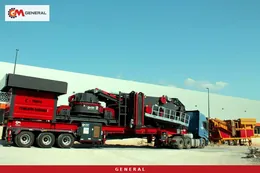
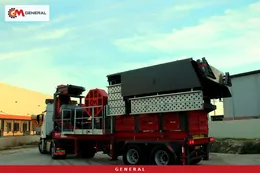
For hard rock we propose two independent lines. Line one is the GNR-MC110: the GPJ 110 jaw primary sits on one chassis, the GS1215/DMK03 impact secondary and a 2000×6000 mm four-deck screen on the second. Each chassis weighs 55,000 kg and the primary group can run on its own. Line two combines the mobile primary jaw GNR 110 (180-300 t/h, 0-1100 mm feed) with a mobile pre-screening DMK behind it. The DMK first passes its 0-100 mm feed over a vibrating screen; material already in size bypasses the crusher, and the oversize is reduced to 0-30 mm in two crushing chambers. Liners are manganese, the blow bars are reversible and the hydraulically opening housing shortens part changes.
Together the two lines approach the upper end of the band, depending on rock and product list; the exact figure is calculated after the sample tests. The real operating gain is that one line keeps feeding the batching plant while the other is under maintenance. You can also start with one line during the diversion phase and add the second before the dam body pour.
A stationary line if the dam pour runs long
If quarry and batching plant will stay put for several seasons, a stationary crushing plant on concrete foundations means less rehandling and more screen decks. A sample layout: GNR 140 vibrating feeder (350-600 t/h), GNRK 110 jaw primary (1100×850 mm opening, 200-350 t/h, 110/132 kW), a cone secondary, a twin screen rated 100-500 t/h and a GNR 900 VSI (80-210 t/h) for sand. Cone crusher model data is issued per project. A stationary line needs a platform clear of the powerhouse and spillway excavations, so the layout has to be drawn together with the employer's site plan.
The sand gap: the bottleneck of dam concrete
The 0-5 mm coming off the crushers rarely matches the sand tonnage the batching plant asks for. Jaw and cone stages run coarse. An impact crusher gives more fines, but on hard rock the price is wear. On dam sites this gap is usually closed in one of two ways: river sand or manufactured sand.
Dredging sand from a big river such as the Sanaga looks cheap at first. Yet its grading shifts with the season, it may carry organic matter and clay, and extraction needs its own permit. Manufactured sand comes from the same quarry and the same rock with a controllable grading. The mobile VSI tertiary unit turns oversize into 0-10 mm sand: it takes 0-200 mm feed, runs at 60-250 t/h and limits metal consumption on abrasive rock in rock-on-rock mode. Unused coarse material becomes sand instead of piling up in the stockyard.
If the fines content of the crushed sand exceeds the specification, washing comes in. The GNR screw washer takes 0-50 mm feed at 50-250 t/h; the twin GNR 800 has an 800×8000 mm trough and 2×11 kW motors. Moisture at the screw discharge is typically 15-30%. That variation upsets the water setting at the batching plant, so plan a separate stockpile and enough draining time before washed sand goes to the plant.
Rainy season, river water and site access
Wet seasons in southern and central Cameroon are long, and dam sites usually sit inside dense vegetation. The share of soil and weathered rock in the blasted muck rises; wet clay sticks in the crusher mouth and blinds screen cloths. Bypassing the soil-laden fines with a grizzly feeder ahead of the primary is the first remedy. At the second stage the integrated screen of the pre-screening DMK repeats that separation and cuts the clay load entering the crushing chamber.
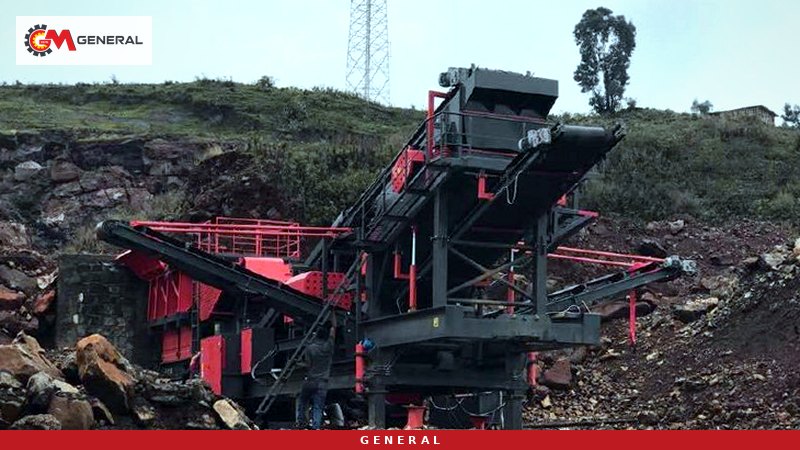
Managing water on the layout takes as much effort as choosing the machines. Build stockyards with a fall and drainage, keep sand piles raised and covered. Put electrical panels in sealed cabinets against moisture and condensation, and set the generator on a platform where rainwater cannot pool. Drawing wash water from the river is easy; returning muddy water to it without a settling pond will not pass environmental permits. Size and place the ponds together with the employer's environmental plan.
Machines normally arrive through the port of Douala or Kribi and travel inland by road. The last kilometres to a dam site are often laterite and may close to heavy vehicles in the rainy season. Build the shipping schedule around the dry period and have bridge load limits on the route checked in advance. The GNR-MC110 helps on such roads because its weight is split over two 55,000 kg chassis, while the General 03 arrives in one piece on its four-axle chassis.
Data to pull out once the specification reaches you
The earlier the quotation work starts, the less the configuration changes. Collect the following in a single file:
- The fraction list of each concrete mix and the daily need per fraction (RCC, mass concrete and structural concrete separately).
- Los Angeles, flakiness and alkali-silica reactivity results for the quarry sample.
- Largest block size after blasting and the soil share in the muck pile.
- Whether river sand will be used and the fines limit for sand.
- Grid power or generator, the source of wash water and the location of the settling pond.
- Route from port to site, bridge limits and the dimensions of the installation platform.
- How long the line stays in one quarry and whether it must move between phases.
Frequently asked questions
Can an impact crusher be used for dam concrete aggregate?
On limestone and medium-hard rock, yes; it gives a cubical, fines-rich product. On gneiss and granite a jaw primary followed by a compression secondary lowers wear cost. An impact secondary still works on these rocks, provided blow bar life is calculated in advance from the test results.
Mobile or stationary?
If quarry and batching plant stay in place throughout the dam pour, a stationary line makes sense. If phases advance at different points, or you plan to take the machines to another site after the project, mobile units fit better. Hybrid solutions that combine a mobile primary with a stationary screening and sand line are also possible.
Which warranty and certificates apply?
Our machines carry ISO 9001 and CE certification. The warranty is 1 year; wear parts such as jaw plates, blow bars and liners are excluded. We have been manufacturing in Izmir since 1976.
What is the quotation based on?
Price depends on model selection, number of crushing stages, screening and washing equipment, generator, transport method and installation scope. Send us the data list above and we will prepare the configuration and quotation from it.
Final assessment
An aggregate plant for a hydropower dam in Cameroon is built around the rock test results and the sand demand of the dam body concrete. On hard gneiss and granite, the two-line jaw layout with a VSI sand unit stands out; on limestone the General 03; and for long work in a single quarry, a stationary line. Send the project specification and quarry sample details through our contact page and we will prepare a configuration and quotation for your site.
Definitions of technical terms: Glossary