EN — English
 TR — Türkçe
 DE — Deutsch
 RU — Русский
 FR — Français
 ES — Español
 AR — العربية
 SR — Српски

Algeria Atlas Quarries Mobile Jaw Crusher and Screener Plant 150-250 TPH
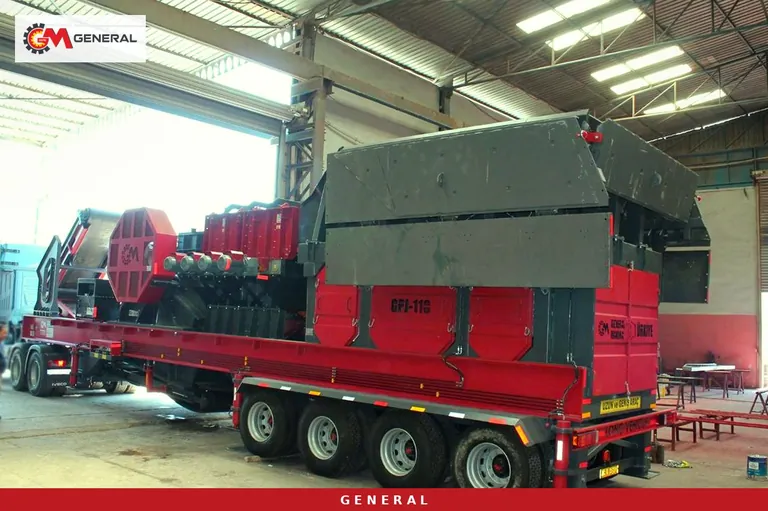
The Atlas ranges that cross northern Algeria from east to west are where most of the country's aggregate quarries sit. A quarry owner choosing a mobile jaw crushing and screening plant here faces different questions from a contractor working on the plains: can the machine climb a steep, winding road up to the bench? Will one plant keep working as the rock changes from one bench to the next? Where does the power come from on a hillside far from the grid? This article walks through the real model options that reach 150-250 TPH, with their figures, and matches each one to the rock and site conditions of Atlas quarries.
In Atlas quarries the rock changes from bench to bench
Most quarries opened along the Tell Atlas and the Saharan Atlas work limestone and dolomite; sandstone, quartzitic layers and marl bands also turn up in places. That variety drives crusher choice directly. In clean, massive limestone an impact crusher runs economically. In sandstone and quartzite with rising silica, however, impact hammers and liners wear fast, and a jaw primary that breaks by compression is the safe option. Marl and clay bands cause trouble less in the crusher than in the feeder, where material sticks, and on the screen, where apertures blind.
That is why the title stresses the jaw. As a quarry works down to deeper levels over the years, the rock can get harder; a line with a jaw crusher at the primary keeps running into a more abrasive seam without changing its first stage. Before deciding, we recommend taking samples from several benches and testing abrasiveness, compressive strength and clay content. The options below are then narrowed down by those results.
Three real routes to 150-250 TPH
No single model covers this whole range at its most efficient working point. Splitting the target into two bands is a better start: a quarry planning around 150 TPH and one approaching 250 TPH look at different machines. You can review all wheeled options in the wheeled mobile crushing plants category. Our delivery in Algeria listed on the site is the 150 t/h project with the General 01; that line has an impact crusher, and below we explain why we lean towards a jaw primary for the Atlas.
| Model | Crushers | Capacity | Feed | Screen | Generator | Weight |
|---|---|---|---|---|---|---|
| General 944 | GPJ 90 jaw + GM430 cone | 120-180 TPH | 800 mm | 1600×5000 mm, 3-deck | 550 kVA | 70,000 kg |
| General 950 | GPJ 90 jaw + DMK01 impact | 120-180 TPH | 800 mm | 1600×5000 mm, 3-deck | 600 kVA | 70,000 kg |
| GNR-MC110 | GPJ 110 jaw + GS1215/DMK03 impact | 200-300 TPH | 900 mm | 2000×6000 mm, 4-deck | 750 kVA | 2 chassis, 55,000 kg each |
| GNR 110 primary jaw unit | GNRK 110 jaw (primary only) | 180-300 t/h | 0-1100 mm | — | — | 55,000 kg |
Lower band, around 150 TPH: General 944 and General 950
The two models share one body: a GPJ 90 jaw primary, 800 mm feed, a 1600×5000 mm three-deck horizontal screen and 0-5, 5-12 and 12-19 mm fractions. The difference lies in the secondary. If the quarry mainly yields limestone and dolomite, the DMK01 impact secondary of the General 950 gives high reduction and cubical chippings. If quartzitic sandstone or siliceous layers dominate, the GM430 cone secondary of the General 944 crushes by compression and keeps metal consumption low. Both sit in the 120-180 TPH band; a 150 TPH target falls in the middle of it, so the crushers work without being pushed to their limit. According to manufacturer data, the General 950 moves on one truck and starts producing within 30 minutes.
Upper band, a 250 TPH target: GNR-MC110
For a 250 TPH target, the direct match in the jaw-primary wheeled family is the GNR-MC110. With 200-300 TPH it leaves headroom above the target, accepts 900 mm feed and makes four products, 0-5, 5-12, 12-19 and 19-40 mm, on a 2000×6000 mm four-deck screen. The primary group (feeder hopper and GPJ 110 jaw) and the secondary group (GS1215/DMK03 impactor, screen and conveyors) sit on separate chassis and can run independently of each other.
That independence gives an Atlas quarry two concrete advantages. Investment can be staged: the quarry first produces coarse crushed material with the primary group alone and sells it for fill and rockfill work, then adds the secondary group once demand settles. And while the secondary group is under maintenance, the primary can keep building a stockpile on its own; in a mountain quarry, not stopping completely while a spare part is on the road makes a real difference.
Staged set-up with a separate primary unit
For quarries that already own a secondary crusher and a screen, the GNR 110 primary jaw unit from the single-chassis mobile crusher units (GNRK 110 crusher, 1100×4750 mm feeder, 180-300 t/h) solves the first stage only. It reduces 0-1100 mm feed to 0-250 mm product and is set up on hydraulic legs without foundations. Graded products need a secondary crusher and screen behind it, so it is a building block that completes existing equipment rather than a full line.
Haulage on mountain roads and set-up on the slope
The last stretch of road up to an Atlas quarry is often narrow, winding and steep. Total weight matters here, and so does the number of pieces it is split into. The primary chassis of the GNR-MC110 measures 3000×13500 mm at 55,000 kg and the secondary chassis 4200×18300 mm at 55,000 kg; the two are towed separately. The General 944 and 950 are single pieces of 4130×20350×4500 mm and 70,000 kg. If the route has bridge load limits, tunnel heights or tight bends, confirm which layout will pass by doing a route survey with the haulage company. For shipments by sea the same dimensions form the basis of both the vessel stowage plan and the road plan from port to quarry.
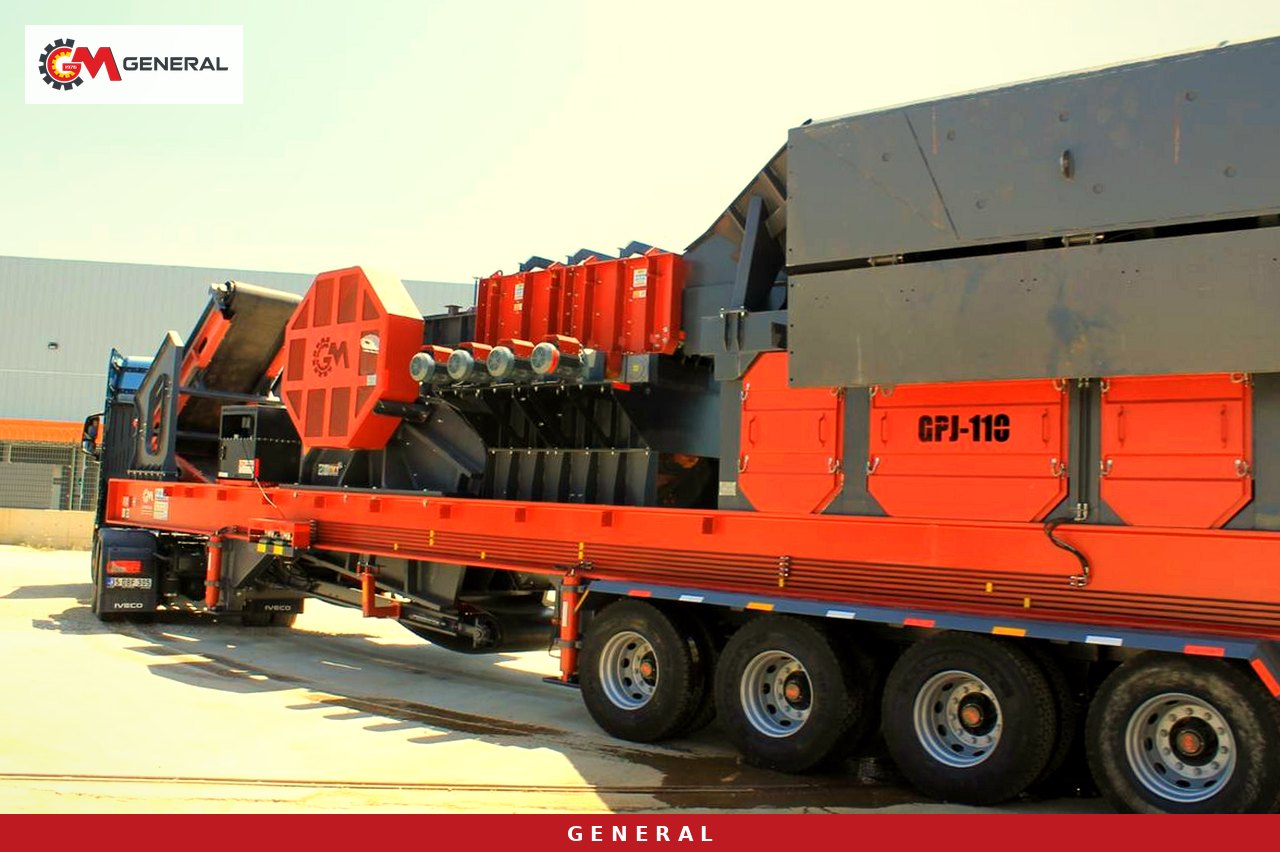
On the slope, the flatness and bearing capacity of the bench floor matter. Wheeled chassis rest on hydraulic legs, and the ground under the legs should be compacted and levelled. If the tipping ramp for trucks, the product stockpile area and the loader's manoeuvring corridor are prepared before the plant arrives, commissioning is shorter. In the twin-chassis layout, the length and slope of the link conveyor between primary and secondary groups should also be fixed on the layout drawing from the start.
The screener side and measures for clayey feed
The screener in the title can sit in two places in the line. On the GNR-MC110, General 944 and General 950 the screen is on board and works in closed circuit: oversize returns to the crusher. A separate mobile screen is meant for other jobs. The GNR ME2060 is a dry screening plant rated at 200-350 tph with a 20 m³ hopper, a 100 mm grizzly over the hopper and a 2000×6000 mm triple-deck screen; it splits material into four fractions in one pass. Its maximum feed is 0-100 mm, so it does not take the 0-250 mm product of a primary jaw directly. It earns its keep on gravel beds in valley floors, in re-screening stockpiles or in pre- and post-screening around a crushing line.
On marl-bearing benches the problem usually shows up not in the crusher but in the feeder and on the screen. The by-pass section of a grizzly feeder removes fines and soil before the crusher, protecting both capacity and jaw plate life. With high clay content and wet feed, the mobile jaw unit with wobbler feeder tumbles stones over rotating shafts so they rub against each other and shed clay, and keeps working where a grizzly blinds. Its 250-450 t/h capacity sits above the target range; it should only come up in quarries where clay really limits output. Periods after winter rains, when wet material increases on the quarry floor, should be built into the production plan from the outset.
Power, dust and seasonal operation
A large share of Atlas quarries lie far from medium-voltage lines, so the generator is an integral part of the equipment list. Per manufacturer data, the General 944 is paired with a 550 kVA generator, the General 950 with 600 kVA and the GNR-MC110 with 750 kVA. The ME2060 runs on a generator or mains power. Fuel tank volume, refuelling frequency and the days when the road may close in winter must be planned together; in a mountain quarry, the day fuel does not arrive is the day the plant stops.
In summer the hot, dusty air of the interior puts cooling of engines and electrical panels in the foreground. Measures that can be selected per project include water-spray dust suppression at crusher discharge and conveyor transfer points, belt covers and frequent checks of the generator air filter according to dust load. On the ME2060 a fan-cooled electrical panel is standard. In winter, frost on the high benches can cause trouble in water lines and make wet material stick to hopper walls; laying water lines so they can be drained is a simple but effective measure.
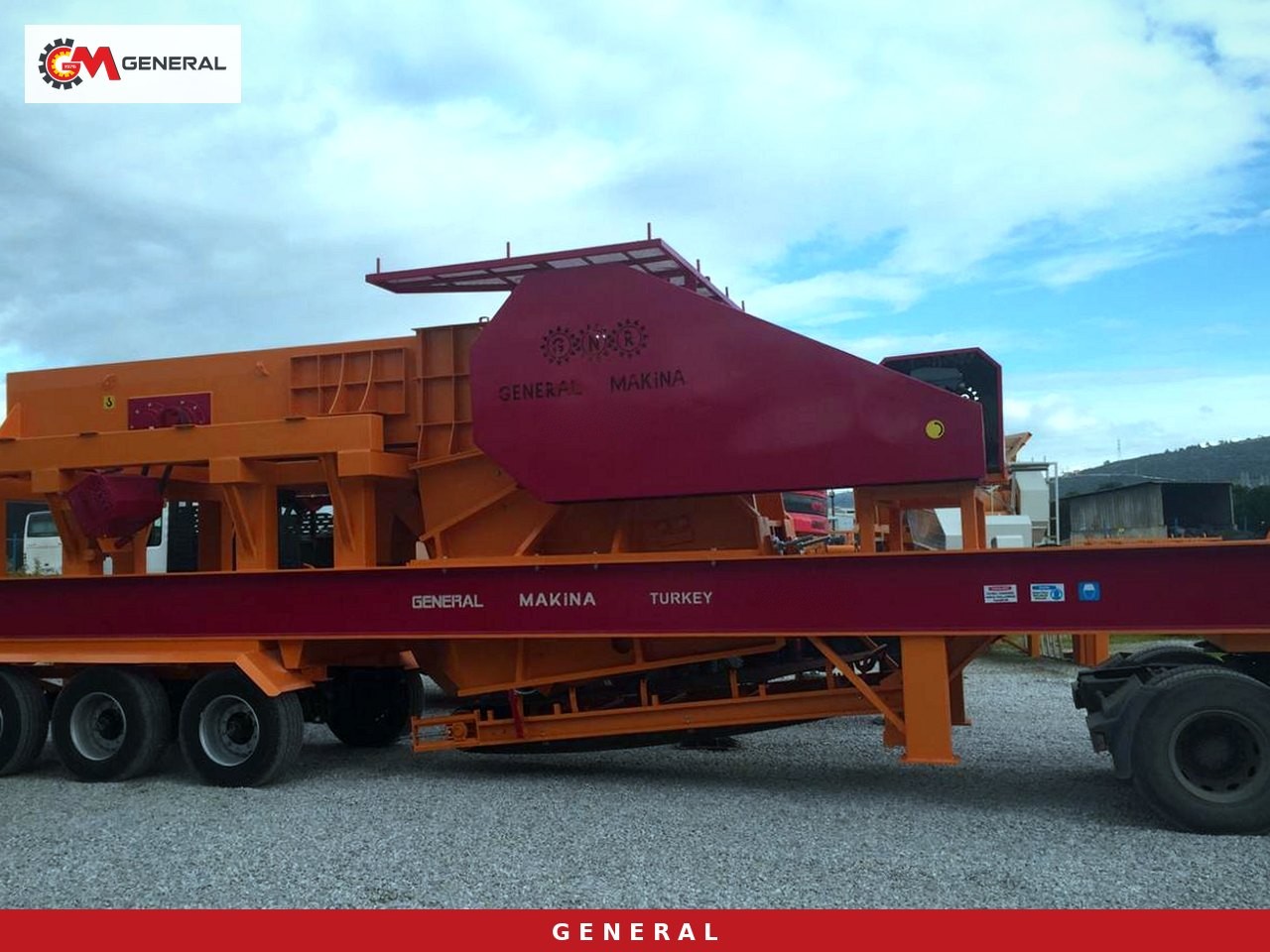
On the wear side, the jaw plates of GPJ jaw crushers are austenitic manganese steel that work-hardens under impact. For a mountain quarry, ordering a spare jaw set with the first delivery is the surest way not to depend on road and customs times when parts need changing.
Quarry data to prepare before asking for a quote
A model recommendation is only as accurate as the data that comes from the quarry. When you fill in the list below and send it to us, we can base the proposal on measurement rather than guesswork:
- Rock type and how it changes by bench; any abrasiveness, compressive strength and clay content test results.
- Largest block size after blasting: below 800 mm, or approaching 900 mm? This directly decides between GPJ 90 and GPJ 110.
- Target hourly output, daily operating hours and shift pattern.
- Required products and their ratios: chippings, sub-base material, crushed sand, coarse fill.
- Width, gradient, bridge and tunnel details of the last road section up to the quarry.
- Power source: distance to the grid, or generator preference.
- Water access for dust suppression and the dimensions of the set-up area.
The main factors that set the price are model and secondary type, extra stockpile conveyors, generator, screen mesh choice, spare parts package and shipping method. All our plants are built under ISO 9001 and CE and carry a 1-year warranty, wear parts excluded.
Frequently asked questions
Does it make sense to start an Atlas quarry with the primary group only?
With the GNR-MC110, yes. The primary group runs independently and can supply coarse crushed material for fill and rockfill work. For graded products such as chippings and crushed sand, the secondary group and the four-deck screen must come in.
GPJ 90 or GPJ 110?
Two figures decide: the largest block and the target tonnage. The General 944 and 950 with GPJ 90 work at 800 mm feed in the 120-180 TPH band. If blocks approach 900 mm and the target is above 200 TPH, the GNR-MC110 with GPJ 110 is the right candidate.
If the quarry is clean limestone, wouldn't an impact primary be cheaper?
It can be, if the rock is clean and low-abrasive on every bench; our General 01 project in Algeria is an example of that approach. The General 01 produces 120-180 TPH on 700 mm feed with a GPS 1210 impact crusher. If there are siliceous sandstone or quartzitic layers, or if the rock will harden on deeper benches later, a jaw primary is the safer investment.
How are price and delivery date settled?
Both depend on the chosen configuration, extra equipment and shipping method. Once we have the quarry data above, we prepare a technical and commercial offer specific to you.
Conclusion
For an Atlas quarry targeting around 150 TPH, the General 944 or General 950 stands out; when the target approaches 250 TPH, the twin-chassis GNR-MC110 does. Rock abrasiveness, largest block size, the chassis size the mountain road allows and the power source decide the choice. Send your sample results and site details through our contact page and we will work out the right configuration and offer for your quarry together.
Definitions of technical terms: Glossary