EN — English
 TR — Türkçe
 DE — Deutsch
 RU — Русский
 FR — Français
 ES — Español
 AR — العربية
 SR — Српски

Africa Laterite Ground: Siting a 100-200 TPH Mobile Stone Crusher Plant
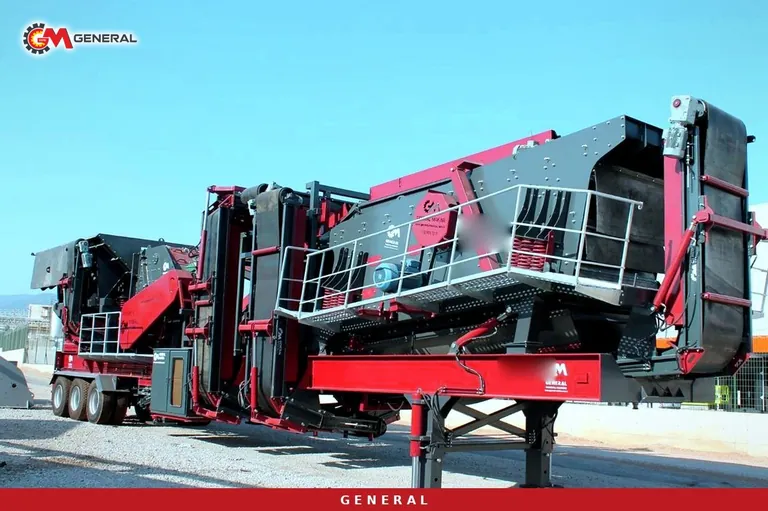
On an African quarry site, the first day of a mobile crushing and screening plant usually brings a surprise from the ground rather than from the machine. Red laterite that feels as hard as concrete in the dry season softens under the wheels and outriggers after the first heavy rain: the tractor unit slips, the chassis loses its level, the screen angle drifts and the conveyor heads start discharging onto the wrong part of the stockpile. This article explains where, how and with what preparation a 100-200 TPH mobile stone crusher plant should be sited on laterite-covered ground. Model figures come from our product pages; site-specific matters such as soil bearing value, rainfall and local permits must be based on a geotechnical survey and the relevant authority.
The siting problems laterite causes
Laterite is a soil-gravel layer enriched in iron and aluminium oxides by tropical weathering. In West and Central Africa, on the East African plateaus and along the southern fringe of the Sahara it is widely used as road sub-base, which shows that it can make a good platform when properly compacted. The difficulty is that you meet the same material in three states: a loose, dusty crust at the surface; a hardened, cemented layer below it that sometimes breaks like rock; and underneath that a weathered, clay-rich zone that holds water.
A mobile plant concentrates its load on a few points: the axle group, the outrigger legs and the kingpin connection. If one of those points lands on a thin crust above the clay zone, settlement that goes unnoticed in the dry season appears suddenly after the first rain. Screen vibration also compacts loose ground over time; as one corner of the chassis sinks millimetre by millimetre, the screen gains a side tilt, material piles up along one edge of the mesh and grading efficiency drops. On laterite, where and how the plant is set down affects output as much as the crusher model does.
Plant location: quarry face, haul road and water path
Three lines belong on the same site map: the direction in which the blasted or excavated face advances, the loop of loaded trucks and the wheel loader, and the natural flow path of rainwater. Placing the plant very close to the face shortens haulage but adds blast vibration and flyrock risk; placing it too far lengthens the loader cycle and starves the feed hopper. The advantage of a mobile plant is that it can be relocated as the face advances, so the first platform should be chosen with the second and third positions of the coming months already in mind.
Slope and drainage
The costliest mistake on laterite is setting the plant in a natural hollow or on a water collection line. The platform should sit slightly above its surroundings with a gentle fall that carries water away from the plant, and the fines channels under the crusher and screen, together with perimeter ditches, should be cut before the rainy season. Spray and dust suppression water must also be accounted for: if it collects around the chassis legs, laterite softens even in the dry season.
Wind direction and dust
In the dry season the laterite crust gives off a very fine red dust. Learning the prevailing wind direction from local sources and placing the generator and control panel upwind, with the fine stockpiles downwind, protects both air filter life and the operator's view. Routing the haul road past the side of the plant rather than its front reduces the dust carried into the feed area; regular watering of the road is a simple measure that can be added per project.
Platform preparation: stripping, compaction and leg pads
The soft, organic top of the laterite cover should be scraped off, and if a cemented layer exists the platform should rest on it. Where there is no cemented layer or the clay zone lies close to the surface, a base is built by spreading coarse quarry rock or the crusher's own coarse fraction in layers and rolling each one. The goal is not a flat surface but a surface that behaves evenly under load: the spots under the axle group and the outrigger legs must have the same density.
Steel plates or thick timber mats wider than the leg foot spread the load. The crusher zone and the screen zone are the two most heavily vibrating points of the chassis; legs in these zones should be checked at the start of every shift during the first week. The base thickness and pad size that are sufficient must be determined by a geotechnical assessment such as soil sampling and a plate load test; guessing them means realigning the chassis on site later.
Model weight and length change the ground plan
Our wheeled models that suit a 100-200 TPH target differ in weight, length and generator rating. These differences directly affect platform length, the area to be compacted and where the generator sits. The whole range is on the wheeled mobile crushing plants page.
| Model | Weight | Generator | Transport dimensions | Pad note | Capacity | Max. feed |
|---|---|---|---|---|---|---|
| General 800 | 35,000 kg | 450 kVA | 3600×15500×4500 mm | lightest; short pad | 80-150 t/h | 600 mm |
| General 01 | 55,000 kg | 550 kVA | 4300×18500×4500 mm | single chassis, impact primary+secondary | 120-180 t/h | 700 mm |
| General 944 | 70,000 kg | 550 kVA | 4130×20350×4500 mm | long chassis; reinforce axle zone | 120-180 t/h | 800 mm |
| General 950 | 70,000 kg | 600 kVA | 4130×20350×4500 mm | same size as 944; larger generator | 120-180 t/h | 800 mm |
| GNR-MC110 (two chassis) | 55,000 kg + 55,000 kg | 750 kVA | 3000×13500 mm + 4200×18300 mm | two separate pads at one level | 200-300 t/h | 900 mm |
Two things can be read from the table. First, in the 120-180 t/h band General 01 fits primary and secondary crushing onto one chassis with an impact crusher, so it is lighter and shorter than its jaw-cone and jaw-impact siblings; on a platform prone to softening, that means less area to compact. If the rock is limestone or another low-abrasion stone, General 01 is a balanced starting point for laterite sites; the same model's 150 t/h project in Algeria runs in this tonnage band. Second, if granite, quartzite or basalt lies under the laterite cover, wear becomes the dominant factor and a jaw + cone layout such as General 944 is needed; in that case the platform for a 70,000 kg single chassis must be longer and the axle zone better compacted.
Two-chassis layout for 200 TPH and above
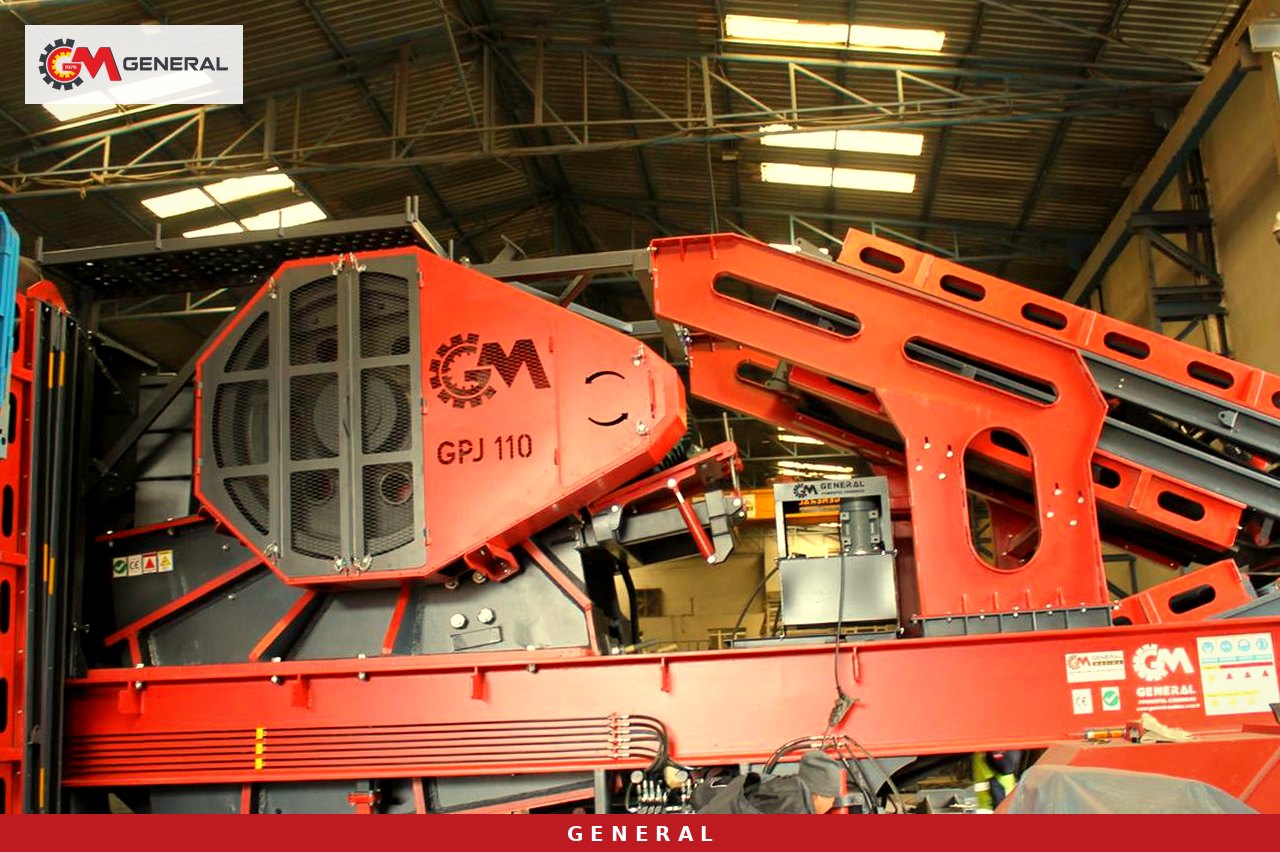
If the target rises above 200 t/h, GNR-MC110 needs two separate platforms: the GPJ 110 jaw primary and feed hopper on one chassis, the DMK03 impact secondary with a 2000×6000 mm 4-deck screen on the other. Because total weight is split in two, each chassis loads the ground more evenly than a single heavy chassis would; in return, the alignment of the link conveyor between the two platforms must be maintained. On laterite this means both platforms prepared to the same compaction quality and the same level; if one settles, the transfer point overflows. Since the primary group can also run alone, you can prepare one platform first and bring in the secondary after the ground has settled.
Feeding and stockpile areas in the rainy season
With the rains, run-of-mine rock reaches the hopper coated in laterite and clay. A vibrating grizzly feeder separates fines well on dry material, but on wet, sticky feed the grizzly gaps can blind. On such sites a wobbler feeder deserves a look: the GWB1136 model, 1100 mm wide and 3600 mm long with an 18.5 kW motor, feeds material up to 1500 mm at 75-600 t/h, and its elliptical disc shafts tumble clayey feed to shed the mud. Other feeder options can be compared in the feeders category.
Stockpile areas are part of the ground decision too. The piles under the conveyor heads grow over time and their weight creeps toward the platform edge; they must be built at a safe distance from the chassis legs, on a separately compacted area with its own drainage. The fine fraction (0-5 mm) holds water in the rain and turns its surroundings to mud, so this pile belongs on the low side of the plant and haul road. Collecting the laterite-rich scalpings in a separate heap keeps them from contaminating crushed aggregate, and this material can be used to maintain site roads.
Set-up day checklist
Verifying the following items one by one before the tractor unit enters the platform prevents most alignment problems that could appear in the first shift:
- Platform level and fall measured; water drains away from the plant and perimeter ditches are open.
- Points where the axle group and outrigger legs will bear are marked and compacted to the same quality.
- Steel plates or timber pads for the legs are ready, with spares on site.
- Longitudinal and side tilt of the screen checked before first start-up and at the end of the first shift.
- Generator and panel placed upwind, fuel tank outside the drainage line.
- Truck and loader loop drawn so that it approaches the feed hopper from the side.
- Area where stockpiles will grow kept away from the chassis legs and drained separately.
- Platform location for a second position chosen before the rainy season.
Frequently asked questions
Can a laterite platform be used without pouring concrete?
Most mobile applications use no concrete foundation; a compacted crushed-rock base and leg pads may be sufficient. Whether they are enough should be decided by a soil survey. If the plant will work at one spot for a long time, a fixed plant option is assessed separately.
Should I choose a single machine or two chassis for 100-200 TPH?
For 120-180 t/h, single-chassis models such as General 01, 944 or 950 are enough, and the choice follows rock type. If the upper limit exceeds 200 t/h, plan a two-chassis line such as GNR-MC110 or a two-unit combination.
Does the plant have to be moved in the rainy season?
Usually not, if the platform was prepared with correct drainage. Still, if a second position is prepared in advance according to the advance of the quarry face, the relocation decision can be made in the dry period rather than after the ground has softened.
How do I find out price and delivery time?
Price depends on the model, feeder type, number of screen decks, generator, automation and shipping route. Once you send your rock type, target fractions and site information, a project-specific quotation is prepared.
Conclusion
On laterite, the output of a mobile stone crusher plant depends as much on how the ground beneath it behaves as on crusher power. Choosing the location together with the water path and wind, compacting the platform around the load points and reflecting the model's weight in the ground plan keep production running through the rainy season. Send your site photos, rock sample information and target capacity through our contact page and we will work out a suitable model and layout with you.
Definitions of technical terms: Glossary