EN — English
 TR — Türkçe
 DE — Deutsch
 RU — Русский
 FR — Français
 ES — Español
 AR — العربية
 SR — Српски
Crusher Machine Guarding Requirements: Distances and Interlocks
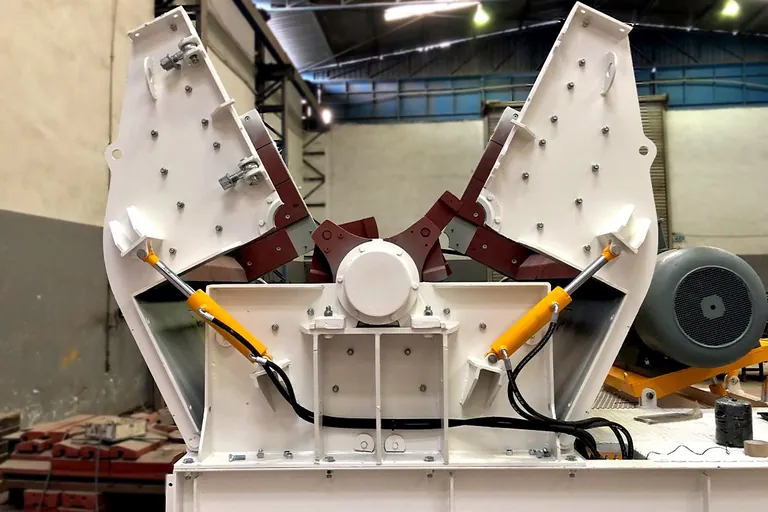
Most injuries around a crushing circuit happen at the drive guard, the flywheel, the conveyor tail pulley and the feeder discharge rather than inside the crushing chamber itself. What these points share is that nobody needs to be there while the plant runs, and everybody goes there when it stops. Crusher machine guarding requirements therefore describe a design problem, not a sheet metal problem: how high the hazard sits, how high the barrier sits, how wide the openings are and how long the machine takes to come to rest.
A barrier only means something together with its distance
Height alone never proves that a guard works. Three dimensions are assessed as one set: the height of the hazardous point above the reference plane, the height of the protective structure, and the horizontal gap between the structure and the hazard. Machinery safety practice treats structures below a certain height as unable to restrict movement at all, and applies a stricter lower limit where the risk is high. The reference plane is the level on which people normally stand. If reaching from a walkway, a pallet or a conveyor frame is foreseeable, the reference plane moves up with them and every distance has to be recalculated from there.
Reach criteria behind crusher machine guarding requirements
| Situation | Dimension assessed | Value |
|---|---|---|
| Reaching upwards, low risk | Height of hazard zone above reference plane | 2500 mm or more |
| Reaching upwards, high risk | Height of hazard zone above reference plane | 2700 mm or more |
| Reaching over a structure | Lower limit for which the tables apply | 1000 mm |
| High risk zone | Structure height needing extra measures | below 1400 mm |
| Square opening, side 12-20 mm | Minimum distance from opening to hazard | 120 mm |
| Upper limb approach | Approach speed used in stopping distance | 2000 mm/s |
| Walking approach | Approach speed used in stopping distance | 1600 mm/s |
The last two rows are the ones plants skip. Any light curtain or interlocked door is positioned using the measured total stopping time of the machine, multiplied by the approach speed and increased by supplementary allowances. Stopping time is measured, never assumed, and it grows as brake linings wear, so the distance has to be revisited during the life of the plant.
Fixed or movable: one question decides it
How many times per shift is the panel opened? A barrier opened only during planned maintenance, using tools, is a fixed guard and bolted fixings are appropriate. A cover opened several times a shift is a movable guard, and because a person can open it by hand, opening it must generate a stop signal. The difference sits in the control circuit rather than in the plate thickness. The common field failure is a guard designed as fixed, then hinged by the crew because they open it daily; it has become a movable guard with no interlock behind it.
When guard locking is the only honest answer
If hazardous motion does not stop the instant the cover opens, the cover itself must stay locked. A rotor or a flywheel keeps turning for minutes after power is removed. Guard locking holds the door mechanically closed until motion has genuinely ceased, and the test is simple: can a person reach the hazard faster than the machine coasts to rest? Devices should also be chosen so they are not easy to defeat. A spare key hanging beside the panel cancels the entire safety function.
Five errors that repeat across sites
First, coarse mesh placed close to the hazard: an opening that admits a finger demands a specific clearance behind it. Second, horizontal members that invite climbing, which turn a tall barrier into a ladder. Third, grease points left behind the guard, guaranteeing the panel is removed every shift; extending the lubrication lines outside solves it permanently. Fourth, heavy covers with no counterbalance, which trap hands and get propped open with a bar. Fifth, no parking position for a removed panel; a guard lying in the mud is a guard that will not go back on.
Auditing what is already installed
An audit is done one machine at a time and with a tape measure rather than from memory. Fix the reference plane first: where does a person actually stand for this task? Then measure the height of the hazardous point and the height of the barrier from that same plane, and take the horizontal gap to the nearest moving component. Measure the largest opening in the panel separately and compare it against the clearance it demands. Finally, time the run-down with a stopwatch after the stop button is pressed, record the result in the machine file and repeat it after every brake component change.
Designing maintenance access into the guard
Guards stay fitted when the routine work no longer requires their removal. Centralised greasing, external belt tension adjustment, inspection windows and quick-release hinges all serve that end. Where a jaw crusher allows belt tension to be set from outside the frame, the drive guard stays closed for the whole campaign, and the same logic applies to feeder drives and conveyor pulleys. This is what turns a written occupational safety measure into one that survives contact with production.
Questions we are asked
Is a taller guard always safer?
Not automatically. Extra height makes reaching over harder but can create a climbing aid and can obstruct maintenance so badly that the panel is removed. Height, horizontal distance and opening size are chosen together.
Is an inspection window worth adding?
Usually yes. Being able to watch the feed without opening anything removes the main reason people open covers. The glazing must resist stone impact and stay clear enough to be useful after a season of dust.
Can guarding be retrofitted to an older plant?
It can, provided the measurements come from a walked-through maintenance scenario rather than a drawing. A barrier installed without knowing which tool is used from which posture usually ends up in the wrong place.
Send us the layout of your existing machines and we will map the access points and propose a guarding scheme that matches how your crews actually work.
Definitions of technical terms: Glossary