 EN — English
 TR — Türkçe
 DE — Deutsch
 RU — Русский
 FR — Français
 ES — Español
 AR — العربية
 SR — Српски
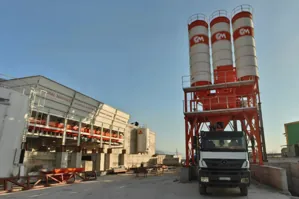
Stationary Mechanical / Soil-Stabilization Plant (Plant-Mix)
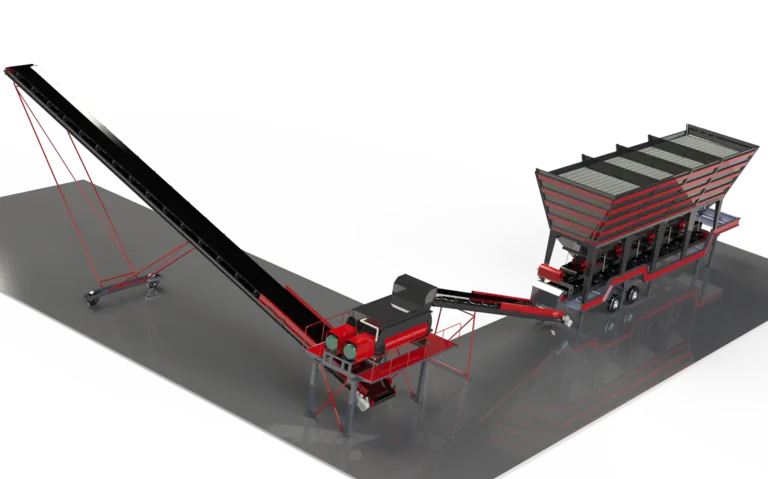
A stationary soil-stabilization plant (mechanical plant / plant-mix plant) is a permanently installed, high-tonnage plant that blends aggregate to a defined gradation with water and cement/binder and mechanically stabilizes it for the base and sub-base layers of highways and roads. Critical distinction: this plant does NOT produce ready-mix concrete; it produces stabilized granular road base (plant-mix / cement-bound granular mixture, CBGM). Unlike a concrete batching plant, the output is not discharged into a truck mixer — it is road base that is hauled to site, spread and roller-compacted.
How it works
Material flow is continuous and high-tonnage:
- Cold silo dosing: 3-5 cold aggregate silos dose the different fractions by recipe (aggregate bin 25×4 = 100 m³).
- Belts: collecting and feed belts carry the aggregate to the mixer.
- Mass cement dosing + water: cement/binder is added by mass dosing and water is sprayed in.
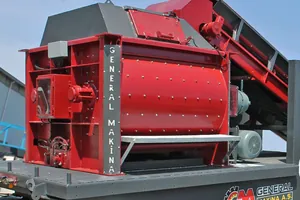
- Twin-shaft mixing: the 2×37 kW twin-shaft mixer homogenizes the plant-mix material.
- Truck loading: discharge into the 25 m³ loading bin → hauled to site by truck, spread and compacted.
Built on a permanent foundation, the plant offers higher capacity and continuity than the mobile version.
Technical specifications
| Parameter | Value |
|---|---|
| Model | Stationary |
| Capacity | 200-750 tph |
| Cold silos | 3-5 units |
| Aggregate bin | 25×4 = 100 m³ |
| Loading bin | 25 m³ |
| Mixer | Twin-shaft 2×37 kW |
| Cement dosing | Mass dosing |
| Total power | 79-155 kW |
| Control cabin | Yes (automation standard) |
Stationary vs mobile
Stationary plant (200-750 tph): higher tonnage, a permanent production base, ideal for large and long projects. Mobile plant (200-600 tph): transportable, follows the advancing road works. For continuous high-tonnage regional infrastructure, the stationary plant is preferred.
Applications
Large highway and road projects, continuous high-tonnage road-base production, regional infrastructure bases and airport runway sub-structure. The product is always road base, never ready-mix concrete.
Single-supplier complete solution
General Makina supplies the crushing-screening line that produces the road aggregate and the stationary plant-mix plant that turns that aggregate into road base from a single supplier. This gives the road contractor one point of contact from quarry to site, with matched equipment and a compatible spare-parts chain.
Frequently Asked Questions
Is a stationary mechanical plant a concrete batching plant?
No. A stationary mechanical plant does not produce ready-mix concrete; it produces cement-stabilized road base (plant-mix / cement-bound granular mixture) for highways and roads. The product is road base spread and compacted on site, not concrete discharged into a truck mixer.
What is the capacity of the stationary plant?
The stationary soil-stabilization plant runs at 200-750 tph with a total installed power of 79-155 kW.
How does it differ from the mobile model?
The stationary model offers higher tonnage (up to 750 tph), a permanent foundation, a larger mixer (2×37 kW twin-shaft) and 100 m³ of aggregate storage; it is a production base for large, long-duration projects.
How is cement dosed and how is the mix made?
Cement/binder is added by mass dosing, water is sprayed in, and the 2×37 kW twin-shaft mixer homogenizes the material. The automation system controls dosing and gradation.
Can I source the road aggregate from the same supplier?
Yes. General Makina supplies the crushing-screening line and the stationary plant-mix plant from a single supplier, giving one point of contact from quarry to road base, with matched equipment and a compatible spare-parts chain.
Wear and spare parts: Spare & Wear Parts
Definitions of technical terms: Glossary
Video
Gallery


Similar Machines
Related Searches
Request a Quote for This Product
Fill in the form and our team will get back to you with a tailored quote.
ISO 9001:2015 · CE · EAC · Since 1976