EN — English
 TR — Türkçe
 DE — Deutsch
 RU — Русский
 FR — Français
 ES — Español
 AR — العربية
 SR — Српски
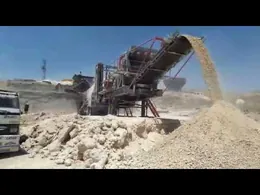
200-250 t/h Dolomite Crushing and Screening Plant
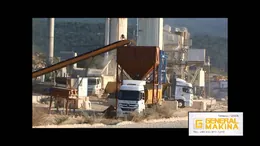
Working footage of our 200 - 250 tonne/hour capacity dolomite crushing and screening plant.
Working footage of our 200 - 250 tonne / hour capacity dolomite crushing and screening plant.
How dolomite behaves while being crushed is noticeable in the video: although the material resembles limestone it is more brittle, so the fines ratio at the crusher discharge looks high.
This puts a load on the screening stage.
As the unwanted fine material increases, the screen surface has to carry that load; in the recording the separation between the screen decks being maintained shows that the aperture selection was made correctly.
The end use of the dolomite determines the choice of fraction: the glass and ceramic industry wants a narrow size range, while road and concrete work accepts a wider distribution.
Stages of the line
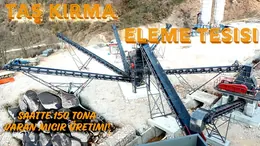
Run-of-mine material is discharged into the feed hopper by excavator or truck; the vibrating grizzly feeder directs the coarse fraction to the primary jaw crusher while bypassing the fines further down the line. The primary discharge goes to the secondary crusher and from there to the screening unit; oversize retained on the screen is returned in closed circuit to the tertiary or secondary crusher. Product fractions are carried to their own stockpiles by separate conveyors.
What determines the capacity
The catalogue figure of 200-250 t/h describes the output obtained with dry run-of-mine material of a suitable feed size and with uninterrupted feeding. Actual site output varies with moisture content, clay content, feed size distribution, how narrow the target fractions are and how much material is recirculated to the crusher in closed circuit. In wet and clayey material screening efficiency drops, so the same line runs at a lower tonnage; in that case a wet screening or washing stage is placed ahead of the line.
Operating notes
Because the fines ratio rises in brittle material, screen area and aperture selection directly determine the achievable capacity. Consumption of wear parts (jaw plates, blow bars, mantle and concave, screen mesh) depends on the abrasiveness of the rock and is the largest single item in operating cost. Regular lubrication, belt tension checks and monitoring the screen surface for blinding prevent the majority of unplanned stoppages.
Project-based solutions
Once you share the rock type, feed size and target fractions of your quarry, our engineering team prepares the flow diagram and the capacity calculation. You can review all line configurations on the products page and contact us through the contact page for a quotation. Dolomite is used with different fractions in glass, ceramics, road and concrete applications.