EN — English
 TR — Türkçe
 DE — Deutsch
 RU — Русский
 FR — Français
 ES — Español
 AR — العربية
 SR — Српски
Mobile crushing plant site commissioning plan
Why commissioning deserves its own plan
A mobile crushing plant site commissioning plan is not about starting the machine. The unit leaves the works mechanically ready; almost all of the time lost on site comes from decisions about ground, access, power and stockpile position that are taken while the plant is already standing there. A commissioning plan pulls those decisions forward and attaches an acceptance criterion to each of them.
The second function of the plan is ownership. If nobody is named for set-down, electrical connection, hydraulic unfolding and first feed, a step is either done twice or skipped entirely. The sequence below exists so that the site crew works from one shared list rather than eight private ones.
Preparation completed before the unit arrives
Ground and layout
The footprint must be compacted, levelled and clear of the low points where water collects. The positions under the hydraulic legs are checked separately, because leg load concentrates on a small area and must never sit on loose fill, a buried service or a freshly backfilled trench. Stockpile areas are marked before the plant lands: the radius the discharge conveyor can reach dictates where the pile grows, and if that direction is chosen badly the conveyor buries itself by the end of the first day.
Power, water and access
Grid supply or generator is decided before mobilisation, because cable size, run length and panel position follow from it. Dust suppression water, a haul route where loaded and empty trucks do not meet head-on, and a maintenance strip left free around the unit all belong on the same sketch.
Set-down, levelling and unfolding order
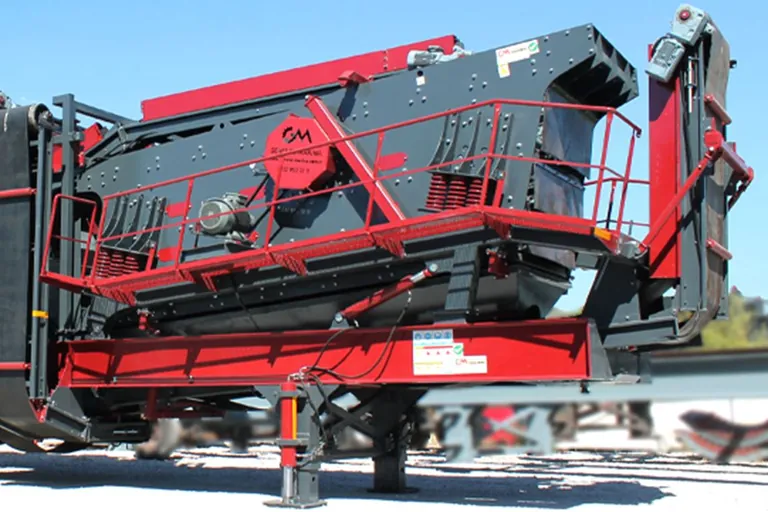
Once the unit is down, levelling comes first. Conveyors are not unfolded on an out-of-level chassis, because a belt erected on a tilted frame throws material to one side in service and ruins the bed distribution across the screen. Hydraulic legs are extended in opposing pairs and checked on both the long and the short axis. Folding conveyors, walkways, handrails and access ladders follow; nobody steps onto a platform before its handrail is locked in place.
No-load running and the controlled first feed
With electrical and hydraulic circuits complete, the plant is run empty. The point of no-load running is to see noise, vibration, belt tracking and oil weeping while there is no material in the machine, when the cost of correcting a fault is zero. Belts are started individually and watched, then the sequenced start from feeder to crusher is tested. The first feed is deliberately thin and single-source: crusher current, flow over the screen and product size are read together, and no setting is touched until all three have been read.
Commissioning schedule
| Step | Task | Acceptance criterion | Record kept by |
|---|---|---|---|
| 1 | Ground and layout acceptance | Compacted, drained footprint; leg positions marked | Site supervisor |
| 2 | Set-down on hydraulic legs | Level confirmed on long and short axis | Erection operator |
| 3 | Unfolding | Conveyors, platforms, handrails and ladders locked | Erection operator |
| 4 | Power connection | Panel earthing and rotation direction verified | Electrician |
| 5 | No-load run | No leaks, belts centred, no abnormal noise | Maintenance lead |
| 6 | Emergency stop test | Every button stops the whole line | Safety officer |
| 7 | First feed | Stable current and target fraction at low rate | Plant operator |
| 8 | Setting and handover | Settings and first sample recorded | Site supervisor |
The setting window of a worked example
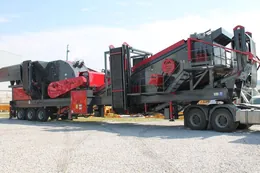
Most layout decisions follow from the feed and discharge window of the unit itself. The figures below belong to the General 01 mobile crushing plant and are the ones used directly when planning stockpile count and truck cycles.
| Parameter | Value |
|---|---|
| Maximum feed size | 700 mm |
| Output size setting | 0-100 mm |
| Final product size | 0-5, 5-12, 12-19, 19-40 mm (standard, can be changed on request) |
| Capacity | 120-180 t/h |
| Optional generator | 550 kVA |
What the first shift must record
Commissioning ends when the first shift log is closed, not when the plant starts turning. Crusher setting, screen apertures, feeder speed, measured product fractions and the reason for every stoppage go onto one sheet. That sheet is the only document that shortens the next set-up: on the following site the same material starts from the same setting instead of being rediscovered by trial and error.
Recurring commissioning mistakes
The most common is producing before levelling is finished; the second is opening the first feed at full rate; the third is letting the stockpile direction collide with the haul route, so the plant runs while haulage jams and rated capacity stays on paper. None of the three originates in the machine. All three are set-up decisions. The other field articles under jobsite and mobile plant follow the same logic into day-to-day operation.
Frequently asked questions: mobile crushing plant site commissioning plan
How many people does commissioning need
Headcount varies with the site. What matters is that each of the eight steps has a named owner; one person may own several steps, but no step may be ownerless.
Which material should the first feed use
The material the site will actually produce, fed thin. A trial run on a different feed does not carry its settings into real production.
Does the plan repeat when the unit relocates
Yes. Ground and layout steps are redone on every new site, while the setting steps get shorter whenever the previous site's log exists.
Definitions of technical terms: Glossary