EN — English
 TR — Türkçe
 DE — Deutsch
 RU — Русский
 FR — Français
 ES — Español
 AR — العربية
 SR — Српски

Bin and silo confined space entry safety: before anyone breaks the bridge
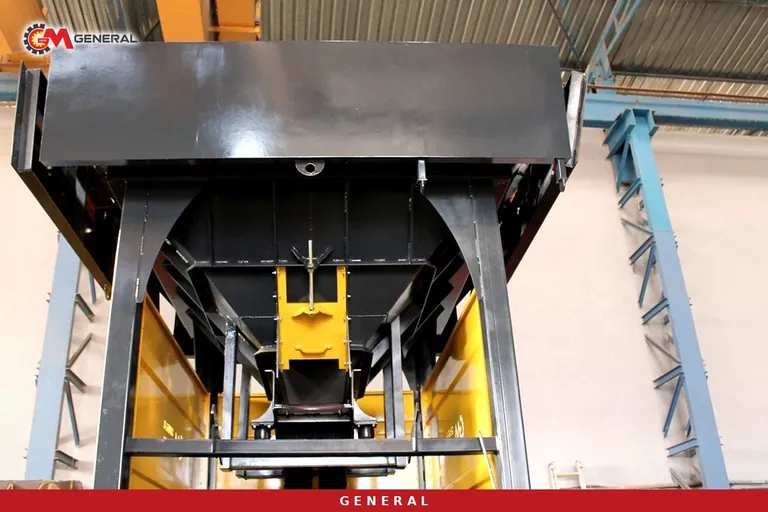
Why this is not ordinary maintenance work
Bin and silo confined space entry safety is the most underestimated heading in a crushing and screening operation. When a hopper blocks, the first instinct is to open the hatch and reach in with a bar; the second is for somebody to climb inside and push the material down. That second instinct is the leading cause of fatal accidents in this work. A confined space is by definition a volume with restricted entry and exit, not designed for continuous occupancy, that may contain a hazardous atmosphere or an engulfment risk. Bins, silos and feed hoppers all meet that description.
Material bridging: deceptive solidity
Fine material, moisture or long dwell time lets a stored solid arch across the walls of a vessel. The top of that arch looks firm enough to stand on while the space beneath it is empty. When the arch collapses, the person on top is submerged in the material within seconds and stops being able to breathe. A rathole, where the centre empties and a shell of material clings to the wall, carries the same risk from the other direction: the wall deposit can release as a single mass.
The resulting rule is not negotiable. Nobody enters a vessel suspected of bridging or ratholing, nobody walks on stored material, and nobody works underneath the discharge opening. Blockages are cleared from outside.
Methods for clearing without entry
| Method | How it works | Where it suits |
|---|---|---|
| External vibrator | Mounted on the cone, reduces friction between particles | Arching in damp fine material |
| Air cannon | Pulses of compressed air move stagnant material | Deposits clinging to the wall |
| Acoustic cleaner | Sound frequencies de-bond material from the wall | Vessels that must not be struck or stressed |
| Bin activator | Keeps the discharge zone in constant motion | Permanent prevention of repeat blockage |
| Remote cleaning service | Whips, drills or similar equipment operated from outside | Heavy, hardened blockages |
Repeated blockage is a design problem rather than a maintenance problem. When an aggregate hopper is specified, evaluating cone angle, internal surface finish, outlet size and the flow behaviour of the stored material together avoids buying a vessel that demands intervention every week.
When entry is unavoidable: the permit system
Welding, liner replacement or inspection sometimes make entry unavoidable. In that case work does not begin without a written entry permit. The permit records the scope, the hazard assessment, evidence of energy isolation, the test results, the names of the entrants and the attendant, the rescue arrangement and the period for which it is valid. It is signed by an authorised supervisor, not by the person doing the work.
Energy isolation
Every item that fills or empties the vessel is stopped, disconnected, locked and tagged: feeder, conveyor, rotary valve, screw and any vibrator. The person entering holds the key. A line filling from above is additionally separated by a blank or a cover; opening a switch alone does not qualify.
Atmospheric testing
| Parameter | Acceptable range | Meaning |
|---|---|---|
| Oxygen | 19.5 to 23.5 percent by volume | Below is deficient, above raises fire and explosion risk |
| Flammable gas | Under 10 percent of the lower explosive limit | Entry is prohibited once the threshold is met |
| Toxic substances | Below the relevant exposure limits | Includes carbon monoxide and hydrogen sulphide |
Testing happens before entry and continues throughout the work. The instrument is lowered so that separate readings are taken from the upper, middle and lower zones of the volume, because heavier gases collect at the bottom. Ventilation is provided with air; enriching the space with oxygen is never acceptable.
What the attendant does
The attendant stays outside the space for the whole of the entry and is given no other task. The duties are to track how many people are inside and how they are, to maintain continuous communication, to order evacuation the moment a prohibited condition appears, and to summon rescue when needed. The conditions that trigger evacuation are explicit: a reading leaving the acceptable range, signs of exposure in the entrants, a hazard developing outside the space, or the attendant becoming unable to perform the role.
One rule matters above the rest: the attendant does not enter to rescue. A large share of confined space deaths are would-be rescuers who went in unprepared for the first casualty. Rescue is planned in advance and executed from outside, using harness, line and retrieval equipment provided for that purpose.
An arrangement that works on site
A durable solution has three layers. The first is physical prevention: locked grating over top openings, guarding at the discharge and restricted access to climbing points. The second is permanently fitted flow aids, so the need to intervene falls away. The third is training and drill, with the supervisor who signs the permit, the attendant and the entrant rehearsing the same scenario at least once a year. Related plant-wide practices sit under occupational safety.
Common questions
Is a permit needed for a short entry?
Yes. A short duration does not lower the risk; engulfment and atmospheric hazards exist from the first second inside.
Can dry coarse material still bridge?
It can. Coarse material arches through mechanical interlock, and that kind of arch usually fails more suddenly.
Does emptying the vessel remove the hazard?
No. Wall deposits can release as one mass, and an apparently empty vessel is still a confined space.
Can one person test the air and enter alone?
No. Even with valid readings, entry does not take place without an attendant stationed outside.
Definitions of technical terms: Glossary