 EN — English
 TR — Türkçe
 DE — Deutsch
 RU — Русский
 FR — Français
 ES — Español
 AR — العربية
 SR — Српски
Log Washer (Coarse Material Washer)
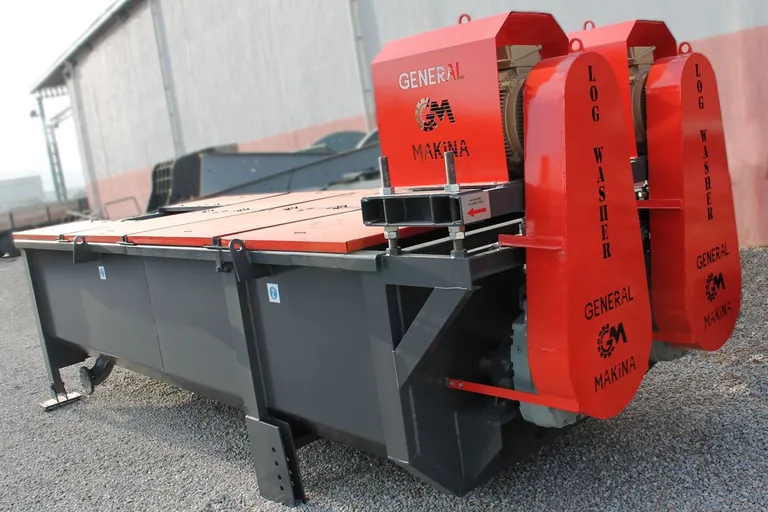
The log washer (coarse material washer) is a heavy-duty washer that separates sand, chippings and ore from clay, silt and alluvial residue. The wear-resistant manganese paddle arms of two counter-rotating log shafts apply mechanical impact (attrition) to the material. Feed is 0-200 mm (it washes coarse stone), capacity 50-250 tph.
How it works
In the washing trough, two gearmotor-driven log shafts rotate at the same speed in opposite directions; their manganese paddle arms break plastic, sticky clay with high shear (attrition).
- Material is fed into the washing trough.
- Two counter-rotating manganese-paddle shafts break and strip the clay by mechanical impact.
- Clay- and silt-laden water is removed at the top.
- Clean material exits through the discharge chute.
Installation incline is 0-14°; the more harmful/clayey the material, the steeper the incline, extending residence (attrition) time. Difference from a screw washer: it can wash larger stone/material and break the hardest clay.
Technical specifications
| Parameter | Value |
|---|---|
| Feed size | 0-200 mm (coarse stone) |
| Capacity | 50-250 tph |
| Shafts | Two counter-rotating log shafts |
| Paddle arms | Manganese alloy (seal-nut, easy-change tips) |
| Bearings | Rotor bearings with seal protection against water |
| Installation | Stationary or mobile |
| Optional | Variable-speed drive, auto lubrication, nozzle rinsing, water recirculation pump, Hardox tub lining |
| Model/size table | Project-specific — set in the quotation |
Model and size are selected per project according to target capacity, clay severity and feed size; no fixed value is stated.
Clay and water recovery
The log washer is for the toughest clayey/plastic material; excess water is discharged through the chute without rising above the working angle. A water recirculation pump minimizes water loss, reaching recovery of the order of ~95%. To quantify the clay load, run an SE (Sand Equivalent) test or read the MBV (Methylene Blue Value) on site. For a drier product the washed material is fed to a dewatering screen; moisture drops to 8-20%.
Areas of use
Use: highly clayey/alluvial river material, clayey ore washing, construction-industry-chemical aggregate and concrete-plant feed. This heavy-duty machine is laid out to handle coarse stone (0-200 mm) and the most stubborn plastic clay. When the material is only fine sand the screw washer suits it, and where clay is low with water saving as priority the bucket wheel is more economical; clay severity and feed size settle the final choice.
Single supplier for the heavy-clay line
On high-clay feed the log washer is engineered as an integrated plant with pre-screening, the GNR YM washing-screening group, a dewatering unit and a concrete batching plant. General Makina takes on the whole chain from crusher to plant under one signature, guaranteeing parts compatibility and service continuity.
Frequently Asked Questions
How does the log washer differ from a screw washer?
The log washer washes coarser material (0-200 mm) and breaks the hardest, plastic clay by mechanical impact (attrition). The screw washer is for scrubbing fine sand (0-50 mm).
How does it work?
In the washing trough, two counter-rotating manganese-paddle log shafts break and strip clay with high shear (attrition); clean material exits through the discharge chute.
What is its capacity and feed size?
Capacity is 50-250 tph and feed up to 0-200 mm coarse stone.
Does it save water?
With the optional water recirculation pump, water loss is minimized and recovery reaches the order of ~95%.
What are the paddles made of, and how do they resist wear?
The paddle arms are manganese alloy (work-hardening under wear); optional Hardox tub lining and seal-nut easy-change tips extend wear life.
Wear and spare parts: Spare & Wear Parts
Definitions of technical terms: Glossary
Gallery


Similar Machines
Related Searches
Request a Quote for This Product
Fill in the form and our team will get back to you with a tailored quote.
ISO 9001:2015 · CE · EAC · Since 1976