 EN — English
 TR — Türkçe
 DE — Deutsch
 RU — Русский
 FR — Français
 ES — Español
 AR — العربية
 SR — Српски
Bucket Wheel Sand Washer
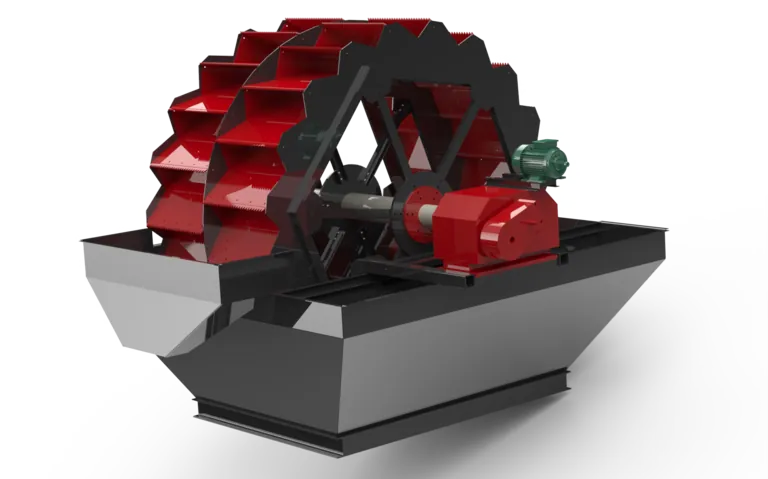
The bucket wheel sand washer raises sand quality by cleaning clay off it while providing low power draw and water saving. Its feed is 0-50 mm and its working capacity lies in the 50-250 tph band. Its simple design offers easy installation and low operating cost.
How it works
Buckets on a rotating wheel lift sand out of the sand-water mix; water and fine clay-silt flow to the bottom and overflow, and clean sand is discharged from the buckets.
- The sand-water mix enters the washing tank.
- The rotating wheel buckets lift sand out of the water (partial dewatering).
- Suspended silt and clay leave with the overflowing light water.
- Partly dewatered clean sand is discharged.
Compared with a screw washer it scrubs less but uses less water and energy — an economical choice for low-clay material.
Machine data
| Parameter | Value |
|---|---|
| Feed size | 0-50 mm |
| Capacity | 50-250 tph |
| Features | Simple design, water saving, low power draw, easy installation |
| Optional | Frequency converter (variable speed) |
| Model/diameter table | Project-specific — set in the quotation |
Wheel diameter and model are dimensioned separately for each site from the required tonnage and feed; no standard chart is published.
Water saving and TCO
Because the buckets lift sand out of the water, the machine also achieves partial dewatering and uses less water than a screw washer. In total cost of ownership, water and energy consumption are the main items; at water-constrained sites and low-clay pits the bucket wheel washer gives a low operating cost. If drier sand for direct stockpiling is wanted, a dewatering screen is added to the line and moisture is pulled into the 8-20% band. The Sand Equivalent (SE) or Methylene Blue Value (MBV) reveals the residual clay in the washed sand.
Where it is used
Used at: low-clay sand-and-gravel pits, sites where water is expensive, economical sand washing and concrete-plant aggregate. The wheel-and-bucket layout stands out where clay is light and water/energy saving matters. If fine sand needs more intensive scrubbing choose the screw washer, and where tight plastic clay and large stone appear the log washer is the right pick.
One-contract project and commissioning
On a line laid out for water-constrained sites, the bucket wheel washer can be delivered under a single contract together with GNR YM plants, the dewatering group and a concrete batching plant. Responsibility is not split across the crushing-screening-washing chain, and spares and service run from one point.
Frequently Asked Questions
How does the bucket wheel washer differ from a screw washer?
The bucket wheel washer uses less water and energy and is economical for low-clay sand. The screw washer scrubs fine sand more thoroughly and is more effective on heavy clay.
What is its capacity and feed size?
Capacity is 50-250 tph and feed size 0-50 mm.
Does it really save water?
Yes. The buckets lift sand out of the water for partial dewatering; it uses less water and lower power than a screw washer — suitable for water-constrained sites.
Is a frequency converter available?
A frequency converter is optional and gives the wheel variable speed.
How do I get price and model information?
The bucket wheel washer's model and wheel diameter are project-specific. Send General Makina your target capacity, material type and clay content; a project-specific configuration and price are provided as a quotation.
Wear and spare parts: Spare & Wear Parts
Definitions of technical terms: Glossary
Video
Gallery


Similar Machines
Related Searches
Request a Quote for This Product
Fill in the form and our team will get back to you with a tailored quote.
ISO 9001:2015 · CE · EAC · Since 1976