 EN — English
 TR — Türkçe
 DE — Deutsch
 RU — Русский
 FR — Français
 ES — Español
 AR — العربية
 SR — Српски
Top-Driven Multi-Slope Screen (Banana Screen)
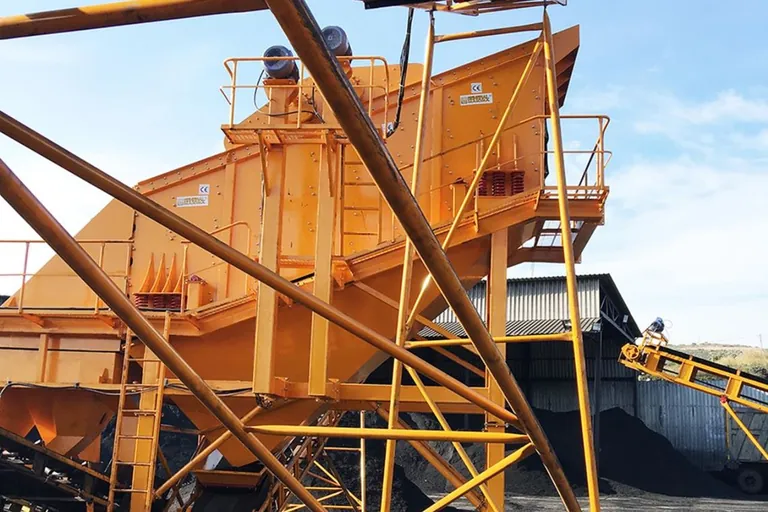
The top-driven multi-slope screen (banana screen) consists of 3 different-slope stages; thanks to the variable slope it gives 30% more capacity than a flat screen of the same size. Capacity is 100-400 tph and the models are ELKK-2565 and ELKK-2580. The whole body is weldless, bolt-assembled; screen media renew easily and the Stone-box front section delays wear.
The three-slope stage logic
Three stages run at different slopes; this three-slope logic is the banana-screen principle:
- Rear stage (steep slope): high flow speed, the material bed is thinned quickly and fines are screened easily.
- Middle stage (classic slope): separation continues.
- Front stage (low slope): residence time increases → efficiency rises.
Thinning the bed quickly on the rear stage uses the screen surface more efficiently; this is the source of the +30% capacity.
Capacity and size
| Model | Screen size (mm) | Motor (kW) | Decks | Weight (kg) |
|---|---|---|---|---|
| ELKK-2565 | 2500×6500 | 2×15 | 3 | 30000 |
| ELKK-2580 | 2500×8000 | 2×22 | 3 | 34000 |
The screens are 3-stage/deck and offer a large surface area (about 16-20 m²). Achieved throughput shifts with the feed grading and moisture and with wet or dry operation; apertures are defined per order.
Typical applications
Large stationary plants requiring high capacity; applications where fines must be separated quickly at the start. Passing more product than a flat screen in the same footprint is an advantage in high-tonnage aggregate production.
Turnkey line
The banana screen usually sits at the heart of a large-scale investment; General Makina takes on that investment as a turnkey project covering crushing, screening, washing and the batching plant. One contract, one responsible team and equipment matched end to end speed up commissioning.
Frequently Asked Questions
What is a banana screen?
The banana screen (top-driven multi-slope screen) is a screen with 3 different-slope stages; the variable slope gives about 30% more capacity than a flat screen of the same size.
Why does it give more capacity than a flat screen?
The steep rear stage thins the material bed quickly at high flow speed; the screen surface is used more efficiently and total capacity rises by about 30%.
How many stages does it have?
3 different-slope stages (steep rear, classic middle, low-slope front). The screen has 3 decks.
What is its capacity?
It ranges from 100-400 tph. Capacity varies with material gradation, moisture and whether screening is wet or dry.
Where is it used?
In large stationary plants requiring high tonnage and in applications where fines must be separated quickly at the start.
Wear and spare parts: Spare & Wear Parts
Definitions of technical terms: Glossary
Video
Gallery


Similar Machines
Related Searches
Request a Quote for This Product
Fill in the form and our team will get back to you with a tailored quote.
ISO 9001:2015 · CE · EAC · Since 1976