EN — English
 TR — Türkçe
 DE — Deutsch
 RU — Русский
 FR — Français
 ES — Español
 AR — العربية
 SR — Српски
Hammer Crusher
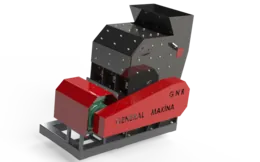
A hammer crusher shown with its body cover open and in operation: rotor hammers, liner plates and the grate basket that sets product size.
In this footage the hammer crusher is shown separately with its body cover open and in working condition. First the arrangement of the hammers on the rotor, then the liner plates on the inner surface of the crushing chamber and the grate basket at the bottom are filmed in close-up.
When the camera goes inside the machine the working logic is read directly: while the rotor turns at high speed the hinged hammers swing out and strike the material, the broken grains hit the crushing plates and are broken again, and they leave the machine only when they have come down to a size able to pass through the grate gap. How the hammers are fitted onto the pins, how the worn face can be turned around and reused, and how the grate basket can be removed and replaced can also be followed in the images.
Product size is determined directly by the grate gap.
In the field this means the ability to reach fine product with a single machine. In materials of low abrasiveness such as limestone, gypsum and coal, the hammer crusher reduces the need for a separate secondary stage thanks to its high reduction ratio. In return, the hammers and the grate are the fastest consumed parts of the line; that is exactly why the easy access emphasised in the video matters.
You can examine in detail the series features of the body, rotor and grate arrangement seen in the recording on the GNRCK Series Hammer Crusher page.